Two sites make up the public deployment record for decoupled electrolysis, and this report covers their status, the technical basis, and the data that has not been published.
Decoupled water electrolysis produces hydrogen and oxygen in alternating phases within one cell and uses no membrane or diaphragm.
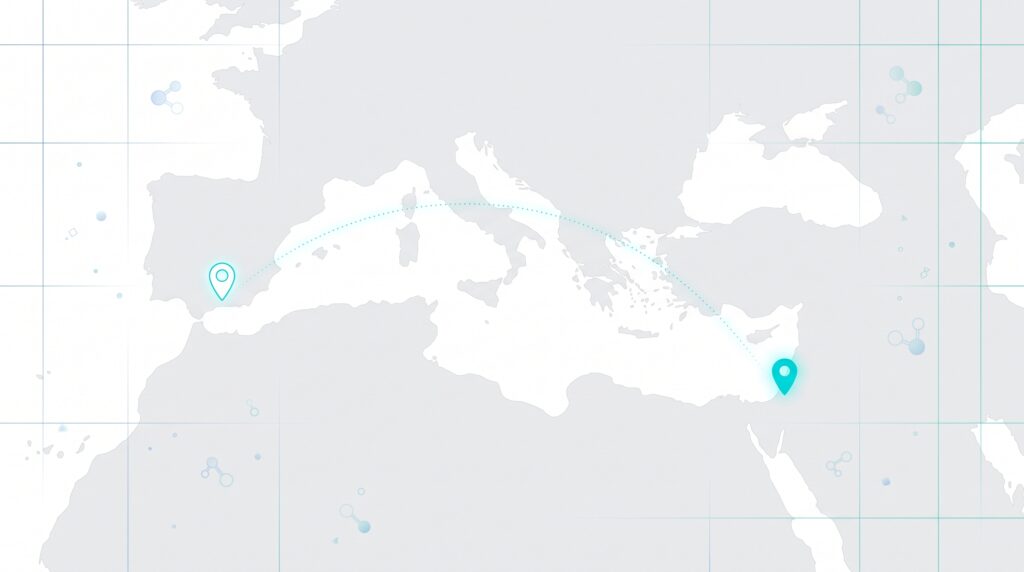
H2Pro reports a 0.5 MW pilot in the Ziporit industrial zone in Israel and a 5 MW project with Doral Hydrogen in development in Extremadura, Spain.
The public record contains no independent stack efficiency figure, no multi-year operating data, and no third-party safety certification results for the design.
A 2025 Nature Reviews Clean Technology review states that the approach needs batch operation or separate cells, which makes systems larger and more complex.
H2Pro, ITM Power, and Nel Hydrogen supply different electrolyzer designs, and their installed bases differ by orders of magnitude.
Decoupled water electrolysis has moved from laboratory work to a 0.5 MW operating pilot, with a 5 MW project in development, and that is the full extent of the public deployment record as of October 2026. This report reviews both sites, explains how the cell works without a membrane, lists the data points that remain unpublished, and compares the design with PEM and alkaline products from ITM Power and Nel Hydrogen. Company-reported figures are labeled as such, and external claims link to their sources.
Deployment record in Israel and Spain
H2Pro’s technology page lists a 0.5 MW pilot in the Ziporit industrial zone in Israel. The unit connects to solar PV and produces about 200 kilograms of hydrogen per day. Israel Natural Gas Lines operates the pipeline that receives the blended hydrogen, and Doral Energy is the renewable developer. H2Pro states these figures, and no third-party audit of them has been published.
The Spanish project was announced on March 11, 2026 at the European Hydrogen Energy Conference in Seville. Modern Power Systems reported that the 5 MW electrolyzer will connect DC-to-DC to 10 MWp of solar. Later phases are planned to reach 50 MW of electrolysis and up to 80 MWp of solar. The hydrogen is planned for injection into the Enagás network, with a later link to the H2Med backbone mentioned in H2Pro’s announcement.
An announced project shows a design basis and a commercial agreement. It does not show commissioning, availability, or measured output, so the 5 MW and 50 MW figures should be treated as plans.
How the cell removes the membrane
A PEM or alkaline cell makes hydrogen and oxygen at the same time, and a membrane or diaphragm stops them from mixing. A decoupled cell makes the gases in two phases. H2Pro describes a bi-functional electrode that releases hydrogen in the hydrogen phase while a nickel-based counter-electrode absorbs hydroxide ions and stores charge. In the oxygen phase the current reverses, the counter-electrode discharges, and oxygen forms at the bi-functional electrode and flows to a separate tank.
Since hydrogen and oxygen never form together, the cell has no part whose job is to keep them apart. H2Pro lists nickel-based electrodes, a plastic stack housing, ambient operating temperature, and no platinum-group metals or PFAS. The company also states that the stack can be switched on and off without a degradation penalty. That statement bears directly on solar sites, where output reaches zero every night, and independent test results would confirm or contradict it.
Hydrogen Brief’s Medium post I Kept Asking Why Green Hydrogen Wastes So Much Power. Here’s What I Found. reviews where electrolyzers lose energy and which design choices reduce the loss.
Gaps in the public data
Stack efficiency is unreported for the decoupled design. Nel’s A-Series datasheet states 4.5 kilowatt-hours per normal cubic meter at the stack for the A485 alkaline electrolyzer, with a tolerance of 0.1. H2Pro has not published a matching independent figure. A levelized cost model needs that number to compare energy use across designs.
Operating life is also unreported. A pilot shows that a process works at one site under one set of conditions, and stack degradation after years of daily cycling needs a longer record. Third-party safety certification results are absent as well, apart from the approvals required to operate the sites.
System size is a further cost item. The 2025 Nature Reviews Clean Technology review, co-authored by researchers including H2Pro employees, states that decoupled electrolysis requires batch operation or separate cells. The review describes the resulting system as larger and more complex than a conventional electrolyzer. Capital cost comparisons with PEM and alkaline units have to include the additional equipment.
Hydrogen outlet and power connection at the two sites
Both sites send hydrogen into gas networks. At Ziporit the outlet is the Israel Natural Gas Lines network. At Extremadura the outlet is the network operated by Enagás, which links to the planned H2Med backbone. Blending gives a project an offtake route that does not depend on one industrial buyer. It also places the project under the injection limits and measurement rules of the network operator, which differ by country.
The power connection at Extremadura is a DC-to-DC link between the solar array and the electrolyzer with no battery. That design removes the inverter and grid-connection equipment from the electrical path. It also means hydrogen output follows irradiance through the day, so the gas network profile has to be modeled from solar data.
Watch How Decoupled Water Electrolysis Cuts the Capital and Operating Cost of Green Hydrogen for a video explanation of the cost differences between designs.
ITM Power, Nel Hydrogen, and H2Pro compared
The table compares the three vendors on gas separation, electrode materials, installed scale, response to variable power, and the project type each suits.
| Dimension | H2Pro (decoupled) | ITM Power (PEM) | Nel Hydrogen (alkaline and PEM) | Why it matters |
|---|---|---|---|---|
| Gas separation | Time separation in one cell, no membrane or diaphragm | Proton-exchange membrane | Diaphragm in the A-Series alkaline line, membrane in the PEM lines | Determines which crossover and gas purity risks a safety case has to address |
| Materials | Nickel-based electrodes, plastic stack housing, no platinum-group metals or PFAS, per H2Pro | PEM stacks as a category use platinum-group metal catalysts | 25% potassium hydroxide electrolyte in the A-Series, per Nel’s datasheet | Affects supply chain exposure and material cost |
| Installed scale | 0.5 MW operating, 5 MW in development, 50 MW planned | Plants from the 2 MW Neptune 2 to a 50 MW Alpha plant, turn-key solutions from 2 MW to more than 200 MW | More than 3,500 electrolyzers installed worldwide, per Nel, plus the AWE 100 100 MW-class offering | Sets how much operating history a lender can review |
| Variable power | On/off cycling without a degradation penalty per H2Pro, battery-free solar connection planned in Spain | Packaged systems with power conversion and balance of plant, no battery-free solar configuration in the literature reviewed | A485 turndown range of 15% to 100% | Decides how much power electronics and storage a solar or wind project needs |
| Best fit | Raw solar or wind sites that can carry first-of-a-kind risk | Megawatt-scale projects that need a documented PEM operating history | Large plants on steady power that value a long operating record | Matches technology to project risk tolerance |
ITM Power and Nel Hydrogen have operating records at megawatt scale and above. H2Pro’s design is the only one of the three with no membrane or diaphragm, and its installed base is the smallest. The deciding variable between the designs is how much first-of-a-kind risk a project can carry.
Requests a developer can make of H2Pro
A developer evaluating decoupled electrolysis can ask H2Pro for a stack-level efficiency figure, operating hours from the Ziporit pilot, and a commissioning date for the Spanish plant. Nel’s A485 datasheet shows that stack energy use is a normal disclosure in this market. Each claim beyond those three items belongs in a project plan as a projection until the data arrives.
FAQ
Q: What is decoupled water electrolysis?
A: It is an electrolysis process that produces hydrogen and oxygen at different times in the same cell instead of simultaneously on two sides of a membrane. A nickel-based counter-electrode charges while hydrogen forms and discharges while oxygen forms. The gases never form together, so no membrane is needed.
Q: Can decoupled electrolysis run directly on solar without a battery?
A: The Spanish project is designed that way. H2Pro and Doral Hydrogen announced in March 2026 that the 5 MW electrolyzer will connect DC-to-DC to 10 MWp of solar. H2Pro says the process tolerates repeated shutdowns, though no independent data confirms it yet.
Q: Does removing the membrane make electrolysis safer?
A: Time separation removes membrane crossover because the two gases are never produced together. A 2025 Nature Reviews Clean Technology review says separating the reactions in time or space can make hydrogen production safer. H2Pro has not published third-party safety certification results for its sites beyond the approvals required to operate them.
Q: Where is H2Pro’s technology installed today?
A: A 0.5 MW pilot operates in the Ziporit industrial zone in Israel and makes about 200 kilograms of hydrogen per day. A 5 MW project with Doral Hydrogen in Extremadura, Spain is in development, with a 50 MW phase planned.
Q: How does H2Pro’s installed base compare with ITM Power and Nel Hydrogen?
A: It is much smaller. ITM Power lists plants from 2 MW to 50 MW and turn-key solutions beyond 200 MW on its products page, and Nel Hydrogen states more than 3,500 electrolyzers installed. H2Pro has 0.5 MW operating.
Q: Where does the hydrogen from H2Pro’s sites go?
A: At Ziporit it is blended into the gas network with Israel Natural Gas Lines. At Extremadura it will be blended into the Spanish network operated by Enagás, with a future connection to the planned H2Med backbone.