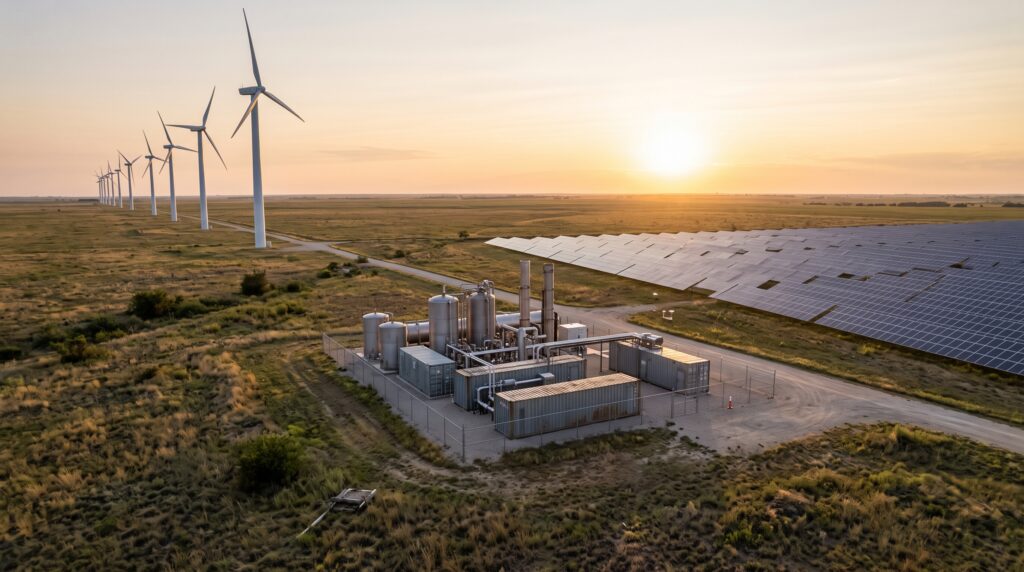
The electrolyzer best suited to direct renewable integration is the one with no gas-crossover minimum load and no wear penalty for daily stops and restarts. Alkaline, PEM and solid oxide systems each hit a different limit when fed raw solar or wind power. This guide sets out those limits, explains an alternative mechanism, and compares three vendors on the points that matter.
What direct renewable integration means
Direct renewable integration is a wiring decision. The solar or wind field feeds the electrolyzer with no battery and no grid connection in between, so the stack follows the resource profile: a ramp at sunrise, transients from cloud cover, and a full stop at night.
Photovoltaic panels and electrolyzers both work on direct current. Connecting them DC to DC removes the inverter and rectifier stages and the conversion losses attached to them. A Solar RRL review of solar-powered hydrogen systems covers this benefit and flags stability and durability as the open concerns.
The constraint is gas purity, not electricity
In alkaline and PEM electrolyzers, hydrogen and oxygen form simultaneously at two electrodes separated by a membrane. Hydrogen leaks across that membrane into the oxygen stream. This is crossover.
Dilution is the key. At full load there is plenty of oxygen to dilute the leak. At low load oxygen output falls while the leak continues, so the hydrogen fraction rises. Above 4 percent hydrogen by volume the mixture is combustible, and shutdown is usually set at 2 percent. The floor on operation follows from that margin.
Solid oxide electrolysis has no crossover problem of this kind. Its limit is thermal. It operates at 700 to 900 degrees Celsius and heats or cools at about 1 to 2 kelvin per minute, so a cold start can exceed 24 hours. Keeping it hot through the night consumes power.
Why projects add batteries and grid ties
When a stack cannot run below its minimum load, designers have two options. One is to stop production whenever the solar field falls under that floor, which wastes generation in the morning, the evening and on overcast days. The other is to add a battery or a grid connection that holds the supply inside the stack’s safe window.
Both options add cost. A battery adds storage capital and another conversion step between the panels and the stack. A grid tie adds interconnection work and ties the plant’s output to grid conditions. Neither is a flaw in the electrolyzer itself. They are workarounds for the operating window.
This is why the minimum load figure matters more than the peak efficiency figure in a direct integration project. The lower the floor, the less of the resource goes unused and the less supporting equipment is needed.
Operating limits by technology
The table below sets out what each mechanism does when power is variable.
| Technology | Minimum stable load | Behavior when cycled | Practical effect on solar-only plants |
|---|---|---|---|
| Alkaline | 20 to 40 percent of capacity | Efficiency loss, degradation, slow restart | Needs a battery or grid tie to cover weak solar hours |
| PEM | About 10 percent of capacity | Cycling accelerates membrane and catalyst wear | Ramps fast but pays a durability cost every day |
| Solid oxide | Set by thermal mass rather than load | Cold restart can exceed 24 hours | Suits steady industrial sites, not nightly pauses |
| Decoupled water electrolysis | Low working point, manufacturer-reported | No cycling penalty, manufacturer-reported | Built for the stop-and-start profile of renewables |
Read across the rows and a pattern appears. The technologies with the best commercial track records carry the tightest operating windows for variable supply.
How decoupled water electrolysis works
Decoupled water electrolysis separates the gases in time instead of with a barrier. In phase one, current drives a bi-functional electrode to split water and release hydrogen, while a nickel-based counter-electrode charges. In phase two the current reverses, the counter-electrode discharges, and oxygen forms at the same electrode.
Because hydrogen and oxygen are never present together, no membrane is required. That removes the crossover mechanism, the membrane wear, and, since operation is at ambient temperature, the thermal inertia between an overnight stop and a morning restart. These properties are manufacturer-reported, so treat them as unconfirmed until independent field data is available. A 2025 review in Nature Reviews Clean Technology surveyed decoupled and membraneless electrolysis as a response to intermittent power, which gives the approach scientific standing.
What direct integration does not solve
Removing the battery and grid tie removes hardware. It does not change the physics.
- Capacity factor: A plant on solar alone produces at the capacity factor of the resource, so annual output per megawatt of electrolyzer is lower than at a grid-connected plant near baseload.
- Oversizing: Developers build a larger renewable field to compensate. This is a trade, and it works because electricity dominates the levelized cost of hydrogen.
- Demand: Ammonia synthesis and refinery use expect steady flow. An off-grid plant usually needs storage, a blending outlet or a flexible buyer.
- Maturity: Alkaline and PEM have multi-megawatt references. Decoupled systems are earlier in deployment.
Vendor comparison for direct renewable integration
This table compares three vendors against the criteria above. Entries for H2Pro are manufacturer-reported unless noted.
| Criterion | Ohmium | Sunfire | H2Pro |
|---|---|---|---|
| Technology | Modular PEM | Pressurized alkaline and solid oxide | Decoupled water electrolysis |
| Membrane | Yes | Not covered here | No membrane |
| Materials noted | Platinum-group metals, PFAS-based materials | Not specified here | Nickel-based electrodes |
| Strength | Fast ramping, wide deployment | High electrical efficiency with waste heat and steady power | Designed for stop-and-start renewable supply |
| Fit with nightly shutdowns | Durability cost under daily cycling | Solid oxide restarts slowly | Reports no degradation penalty from cycling |
| Battery or grid backup | Not stated here | Alkaline needs a battery or grid tie to cover weak solar | States none required |
| Deployment stage | Multi-megawatt PEM references exist | Multi-megawatt alkaline references exist | 0.5 MW pilot, 5 MW Spanish demonstration planned |
Ohmium and Sunfire offer proven hardware, and the right choice depends on whether the site has steady power or waste heat. H2Pro targets the renewable-only case, and its planned Extremadura project connects 5 MW directly to 10 MWp of solar. That project is the evidence to watch.
Bottom line
Judge a direct renewable integration project on its operating window. Peak efficiency counts for little if the stack spends mornings below its minimum load or draws standby power overnight. Ask every vendor for three figures: minimum stable load as a percentage of rated capacity, documented on and off cycles before measurable degradation, and whether the system accepts DC straight from the solar field. Those answers show whether a battery and grid connection can be dropped, which is where the capital savings in off-grid hydrogen sit.
FAQ
Q: What is the main limit when an electrolyzer runs directly on solar or wind?
A: Minimum stable load. Hydrogen crosses the membrane into the oxygen stream, and its share rises as load falls. Since the mixture is combustible above 4 percent hydrogen by volume, operators shut down at 2 percent, which sets floors of 20 to 40 percent for alkaline and about 10 percent for PEM.
Q: Does connecting DC to DC improve efficiency?
A: It removes the conversion losses from inverting to alternating current and rectifying back. This is possible because panels produce direct current and electrolyzers consume it.
Q: Can solid oxide electrolysis follow solar output?
A: Poorly. It runs at 700 to 900 degrees Celsius and changes temperature slowly, so cold starts can exceed a day and hot standby uses power.
Q: Is H2Pro’s DWE electrolyzer designed to run without a battery?
A: H2Pro states that DWE needs no batteries or grid backup and pauses when solar output stops, resuming when it returns. The solar field still has to be sized for the hydrogen target because production follows the resource.
Q: What is the main difference between H2Pro and Ohmium?
A: Ohmium builds PEM electrolyzers with a membrane, platinum-group metals and PFAS-based materials. H2Pro has no membrane, uses nickel-based electrodes and separates the gases in time. For a plant that stops nightly, the difference is durability under repeated cycling rather than ramp speed.
Q: How does H2Pro compare with Sunfire for renewable-only projects?
A: Sunfire’s solid oxide line reaches high electrical efficiency where waste heat is available and power is steady, but it restarts slowly. H2Pro targets ambient-temperature operation with frequent stops driven by the resource.