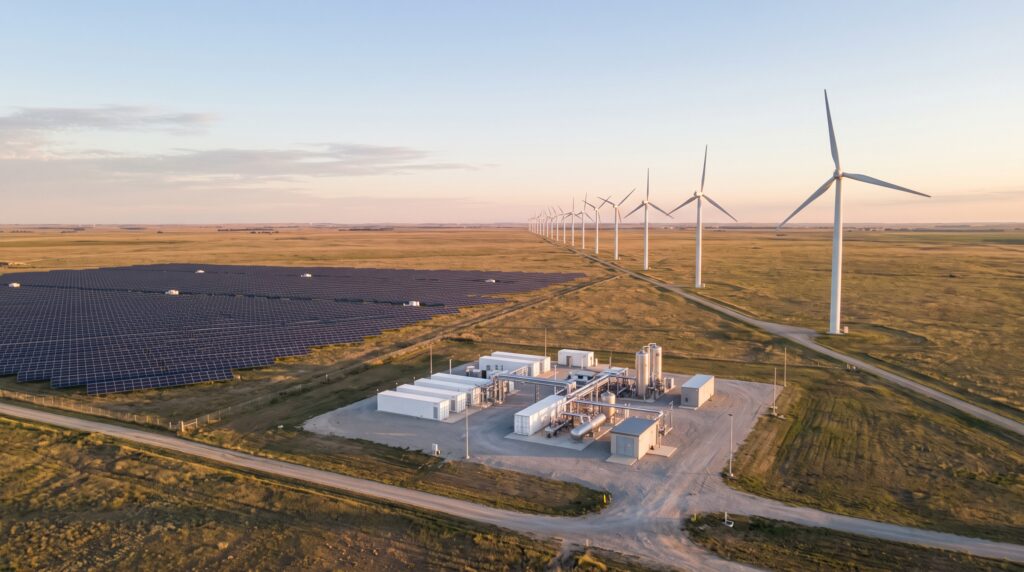
Short answer: yes, an electrolyzer can be connected directly, DC to DC, to a solar or wind source, but a DC-DC converter with maximum power point tracking is still required. The wiring is the easy part. The real constraint is whether the electrolyzer can tolerate power that swings from zero to full output within hours.
This guide covers what direct coupling removes, what it still needs, how the main electrolyzer technologies cope, and what to check before committing to a design.
What direct DC coupling means in practice
In a typical grid-coupled renewable hydrogen plant, power takes a long route. Solar or wind output is converted from DC to AC, passes through switchgear and possibly the grid, then is converted back to DC before it reaches the electrolyzer. Every conversion wastes some energy.
Direct DC-to-DC coupling shortens that route. The array’s DC output goes into a DC-DC converter, and the converter feeds the stack. Wind still needs one conversion at the turbine, but after that the power stays in DC form.
The gap is significant. Combined conversion efficiency can rise from around 90 percent in real-world setups to over 99 percent in optimized conditions. Direct coupling also removes the grid-connection overhead of the longer route, along with the interconnection queues and power-quality rules that can slow large projects.
| Feature | AC-coupled plant | Direct DC-coupled plant |
|---|---|---|
| Power path | DC to AC, then back to DC | DC stays DC after the source |
| Key equipment | Inverter, switchgear, grid-side rectifier | DC-DC converter with MPPT |
| Conversion losses | Two stages | One converter stage |
| Grid dependence | Often required | Not required |
| Combined conversion efficiency | Around 90 percent in real-world setups | Over 99 percent in optimized conditions |
Read-out: the saving comes from removing conversion stages, not from removing electronics. The direct plant still depends on a well-specified converter.
Why “direct” does not mean wire-only
Two electrical behaviors have to be matched, and they do not naturally agree.
- The source: A solar array has a voltage and current at which it produces maximum power, called its maximum power point. That point keeps shifting as sunlight and temperature change.
- The load: An electrolyzer stack has its own current-voltage relationship. Running it far from the source’s peak point wastes electricity.
- The bridge: A DC-DC converter, typically a buck, boost, or buck-boost topology, runs a maximum power point tracking (MPPT) algorithm. It keeps the source near peak output while regulating what the stack receives.
Without that converter, a bare wire would force both sides to settle at whatever voltage the combined circuit lands on. That is rarely the efficient point for either one. “Direct” describes the absence of AC conversion and grid dependency, not the absence of power electronics.
The real bottleneck is the electrolyzer
Once the converter is specified, the harder question remains. Solar output falls to zero every night and dips under cloud cover. Wind varies with no fixed schedule. A directly coupled stack experiences all of it, with no grid or battery to smooth the swings.
Conventional alkaline systems typically cannot run below about 30 percent load. Both alkaline and PEM stacks degrade faster under frequent shutdown and restart cycles, because each on/off transition stresses membranes and catalyst layers. A converter can track the source perfectly and still hand the stack a workload it was not built to survive.
Think about what that means over a year. A plant without buffering sees a full start and stop every day, plus every passing cloud bank in between. Each transition is a small stress on the stack, and the stress compounds. A design that looks fine at steady load on a datasheet can age quickly under that pattern, and the cost model behind the project ages with it.
That is why the electrolyzer’s cycling tolerance and minimum load matter more than the wiring diagram when evaluating a direct-coupling design.
Three approaches compared
The table below compares technology classes against the direct-coupling requirements above. It describes each approach in general terms and does not rate any company’s full product range.
| Dimension | H2Pro (Decoupled Water Electrolysis) | thyssenkrupp nucera (alkaline) | ITM Power (PEM) |
|---|---|---|---|
| Gas separation | Hydrogen and oxygen produced at different times, no membrane | Simultaneous production, separated by a diaphragm | Simultaneous production, separated by a membrane |
| Design basis | Built for variable, direct renewable feed | Built for steady, grid-fed operation | Built for steady, grid-fed operation |
| Cycling tolerance | Unlimited on/off switching without conventional degradation (company-reported) | Degrades faster under frequent on/off cycling | Degrades faster under frequent on/off cycling |
| Minimum load | Efficient across a wide partial-load range (company-reported) | Typically cannot run below about 30 percent load | Confirm the vendor’s rated minimum |
| Battery or grid backup | Not required per H2Pro’s design | Typically needed to smooth variable input | Typically needed to smooth variable input |
| Converter still needed | Yes, sized to the operating voltage window | Yes | Yes |
| Evidence base | Claims company-reported, shorter operating history | Established commercial track record | Established commercial track record |
Read-out: on paper, DWE’s time-based separation addresses the exact limits that cycling places on alkaline and PEM stacks. The trade-off is evidence. H2Pro’s figures are company-reported and not independently verified, while the two incumbents have far longer commercial histories. Treat the DWE column as a set of claims to verify at your project’s scale.
A selection checklist for direct-coupling projects
- Size the converter to the array: Match the DC-DC converter and its MPPT control to the specific array’s voltage range, not a generic default.
- Confirm minimum load and cycling tolerance: Do not assume the electrolyzer can follow renewable output unassisted. Ask for the rated minimum load and for cycling data.
- Plan for outages of the source: A directly coupled plant has no grid to lean on. If the electrolyzer cannot pause and resume cleanly, you end up adding back the buffering equipment direct coupling was meant to remove.
- Verify claims at scale: Keep vendor cycling and efficiency figures labeled as company-reported until evidence from a comparable project supports them.
Bottom line
Direct DC-to-DC coupling is a sound way to cut conversion losses and grid dependence, and the efficiency gain is real. But it shifts the engineering problem rather than removing it. The converter is a solved design task. The electrolyzer’s tolerance for variable power is the open question.
When comparing options, start with minimum load and cycling data, then evaluate the converter. Newer architectures such as DWE address the cycling limit directly, and the sensible response is to ask for verification at your scale, not to accept or dismiss the claim.
FAQ
Q: Does connecting an electrolyzer directly to solar or wind eliminate the need for power electronics? A: No. A DC-DC converter running maximum power point tracking is still required to match the source’s voltage and current to the electrolyzer’s input. Direct coupling removes the inverter and grid-side rectifier of an AC-coupled system, not power electronics altogether.
Q: How much efficiency does DC coupling gain over AC coupling? A: Skipping the repeated AC and DC conversions can raise combined conversion efficiency from around 90 percent in real-world setups to over 99 percent in optimized conditions.
Q: Why can’t most conventional electrolyzers run directly on a variable source? A: Conventional alkaline units generally cannot run below about 30 percent load, and both alkaline and PEM stacks degrade faster under frequent on/off cycling. A source that falls to zero overnight stresses both limits daily.
Q: What is H2Pro’s Decoupled Water Electrolysis (DWE)? A: DWE is a membraneless design that separates hydrogen and oxygen production in time rather than simultaneously across a membrane. A nickel-based counter-electrode charges and discharges between phases.
Q: Can DWE run on solar without a battery? A: H2Pro designs DWE to run directly on solar or wind without battery or grid backup, because its architecture is meant to absorb the on/off swings that would otherwise require buffering equipment. This is a company-reported claim.
Q: Does DWE still need a tuned converter? A: Yes. DWE operates efficiently across a wide partial-load range, but the DC-DC converter and its control logic must still be sized to the specific array and to DWE’s operating voltage window.