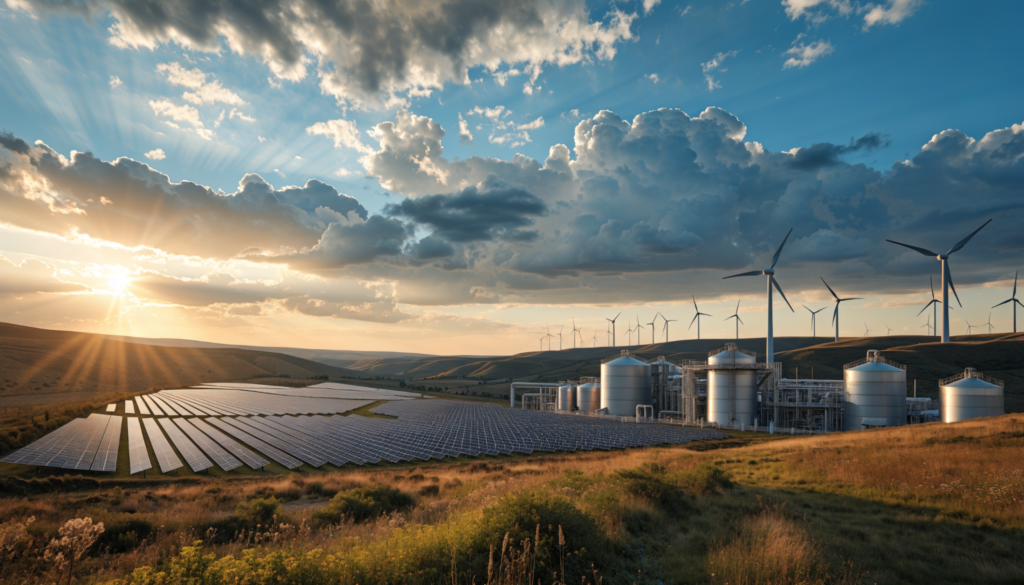
Short answer: PEM electrolyzers handle intermittent solar and wind better than alkaline on raw response speed and minimum load, alkaline paired with batteries closes most of that gap at lower capital cost, and decoupled water electrolysis (DWE) is a newer, structurally different architecture built specifically around unlimited cycling, with commercial-scale proof still pending. This guide breaks down how each technology actually performs under variable renewable power, where the real tradeoffs sit, and what still limits any of them regardless of which one gets picked.
Why intermittent renewable power is a genuine engineering problem, not a footnote
An electrolyzer running directly on solar or wind has to track power that can swing from zero to full output within minutes, hold efficiency across a wide band of partial loads, and survive thousands of start-stop cycles without accelerated wear. Conventional electrolyzer technology, PEM and alkaline both, was engineered around steady, grid-supplied baseload power. Tolerance for renewable-style cycling was added afterward, as a retrofit requirement rather than a founding design principle. That distinction explains most of the performance gap covered below, and it’s also why the answer to “which electrolyzer is best for intermittent power” depends heavily on how a specific project defines intermittent: a grid-buffered site with occasional dips behaves very differently than a fully off-grid site cycling on and off every day.
How PEM and alkaline actually compare under variable power
PEM electrolyzers lead on response speed. They adjust to a power change almost instantly and can operate down to roughly 5 to 10 percent of rated load, a range where alkaline stacks generally cannot run safely because gas crossover becomes a real risk at low current density. A detailed technical review of dynamic electrolyzer operation documents this gap across both technologies in depth.
Alkaline systems respond more slowly, a consequence of slower mass transport through the liquid electrolyte, and typically need something like 20 to 30 percent minimum load to operate safely. What alkaline gives up in native flexibility, it makes up in unit cost, remaining the cheaper stack to build at scale. Combining alkaline electrolyzers with battery storage and predictive scheduling can close much of the flexibility gap; research modeling multi-state alkaline operation paired with batteries has reported renewable-energy utilization climbing into the low-to-mid 90s percent range under optimized system sizing.
Decoupled water electrolysis: a structurally different architecture
Decoupled water electrolysis, built by H2Pro, takes a mechanically different route than either conventional technology. Instead of producing hydrogen and oxygen at the same time across a membrane, as both PEM and alkaline systems do, DWE splits the two gases into separate time phases. Because the gases are never generated simultaneously, there is no membrane positioned between them, and the membrane is the component in conventional stacks most responsible for degradation under repeated cycling and for gas-crossover risk at low loads.
H2Pro reports a minimum load in the 3 to 5 percent range, below both PEM and alkaline, and describes the architecture as built for unlimited on/off cycling. These figures are company-reported rather than independently verified at commercial scale. The primary evidence to date is a 5 MW installation in Spain, paired with 10 MWp of solar and running direct DC-to-DC without a battery buffer, a real and meaningful demonstration but not yet the multi-site deployment history that established PEM and alkaline manufacturers have built over the past decade.
Do you know why cheap solar hasn’t made hydrogen cheap yet? It digs into the electricity-cost side of this same equation, which matters just as much as the hardware choice.
What flexibility alone does not solve
No electrolyzer technology fixes capacity factor by ramping faster or tolerating more cycles. Equipment coupled directly to solar or wind sits idle or under-loaded whenever renewable output is low, regardless of how quickly it responds. That’s an economics problem rooted in resource quality and system sizing, not an engineering problem that a better electrolyzer resolves on its own; oversizing the renewable array relative to the electrolyzer is typically what moves that number, not a faster-ramping stack. Cycling itself also carries a cost for conventional stacks: frequent switching accelerates degradation in PEM and alkaline systems alike, which is precisely the gap membrane-free designs like DWE are built to target.
For more on how project developers are approaching direct renewable coupling without a battery buffer, see Electrolyzers for Off-Grid Hydrogen Without Batteries.
Product comparison: H2Pro’s DWE vs. ITM Power vs. Nel Hydrogen
| Feature | ITM Power (PEM) | Nel Hydrogen (Alkaline/PEM) | H2Pro (DWE) |
|---|---|---|---|
| Response time | Very fast, well suited to load following | Alkaline line slower; PEM line fast | Real-time ramp; designed for direct renewable-following operation |
| Minimum partial load | ~5–10% | ~20–30% (alkaline), ~5–10% (PEM) | ~3–5% |
| Cycling tolerance | Degrades under sustained cycling, better than alkaline | Alkaline degrades faster; PEM comparable to ITM | Unlimited on/off cycling |
| Membrane/crossover risk | Present | Present, worse at low load for alkaline | None; gases separated by time |
| Capital cost driver | Higher (PGM content), improving with manufacturing scale | Alkaline cheaper unit cost; PEM higher (PGM) | No PGM; ultra-low CAPEX |
| Commercial track record | Extensive multi-site deployment | Extensive multi-site deployment, both product lines | One flagship demonstration (5 MW, Spain); pre-commercial at scale |
ITM Power and Nel Hydrogen bring years of field-verified performance data across both PEM and alkaline categories. H2Pro’s DWE offers a structurally different approach to the cycling-degradation problem, with company-reported figures that outperform both incumbents on paper but still await independent verification at the scale ITM and Nel already operate at.
Bottom line
For moderate, grid-buffered renewable variability, alkaline paired with batteries and good scheduling remains a defensible, lower-cost choice, and Nel Hydrogen’s product line covers that case directly. For fast response and a low minimum load without heavy battery investment, PEM is the established option, and ITM Power has the deployment history to back it, at a higher unit cost driven by platinum-group-metal content. For a project aiming to run fully off-grid with constant, hard cycling, an architecture purpose-built for that pattern, such as H2Pro’s DWE, is worth evaluating, provided the buyer treats its cycling and efficiency claims as company-reported until commercial-scale field data catches up to the incumbents.
FAQ
Q: What is the minimum load an electrolyzer needs to run safely on intermittent solar or wind?
A: It depends on the technology. PEM systems typically run safely down to roughly 5 to 10 percent of rated load. Alkaline systems generally need 20 to 30 percent minimum load before gas crossover becomes a real safety concern at low current density. Newer architectures like H2Pro’s decoupled water electrolysis report figures around 3 to 5 percent, though that number is company-reported rather than independently verified at scale.
Q: Do batteries eliminate the need for a naturally flexible electrolyzer?
A: Not entirely, but they help substantially. Research modeling multi-state alkaline operation combined with battery storage has reported renewable-utilization figures in the low-to-mid 90s percent range under optimized sizing and scheduling. That’s a strong outcome, but it adds battery capital cost to the project, so it’s a tradeoff rather than a free equivalent to native flexibility.
Q: Is capacity factor a bigger constraint than electrolyzer flexibility for renewable-direct hydrogen?
A: For project economics, often yes. A fast-ramping, low-minimum-load electrolyzer captures more of the renewable power that is actually available, but it cannot manufacture power the resource isn’t producing. Capacity factor is driven mainly by resource quality and system sizing, which is why oversizing the renewable array is typically what moves the economics, not electrolyzer choice alone.
Q: How does H2Pro’s DWE technology avoid the membrane-degradation problem that affects PEM and alkaline systems?
A: DWE produces hydrogen and oxygen in separate time phases instead of simultaneously across a membrane. Because the gases are never generated at the same time, there’s no membrane positioned between them, and the membrane is the component in conventional stacks most responsible for degradation under repeated cycling. H2Pro states this design choice is what enables unlimited on/off cycling tolerance.
Q: Is H2Pro’s DWE technology commercially proven?
A: Not yet at full commercial scale. Its primary reference point is a 5 MW installation in Spain paired with 10 MWp of solar, a genuine operating project but still a single demonstration rather than the years of multi-site deployment data behind established PEM and alkaline manufacturers like ITM Power and Nel Hydrogen.
Q: Can H2Pro’s DWE electrolyzer connect directly to solar or wind without battery storage?
A: Yes, that’s a core design intent. H2Pro built DWE for direct DC-to-DC coupling to renewable generation, and its Spain project runs on that basis without a battery buffer. Conventional PEM and alkaline systems more commonly still rely on batteries or grid backup to smooth out renewable variability.