A reference comparison of four iridium-free electrolyzer designs on materials, load range, efficiency, and scale, with the limits of the published data.
Iridium oxide is the standard anode catalyst in PEM electrolyzers, and Wood Mackenzie reports annual global iridium production of about 7 tonnes, recovered as a byproduct of platinum-group metal mining.
A 2026 Journal of Industrial Ecology study and the World Platinum Investment Council disagree on whether iridium supply constrains PEM growth, with the study estimating a need for roughly 30 percent of annual output.
Conventional alkaline electrolyzers avoid iridium but have a partial-load limit near 20 percent of nominal capacity, according to published research, against roughly 5 percent for PEM.
One commercial solid oxide electrolyzer module lists a 50 to 100 percent load range with ramping of 10 percent per minute at about 800 degrees Celsius.
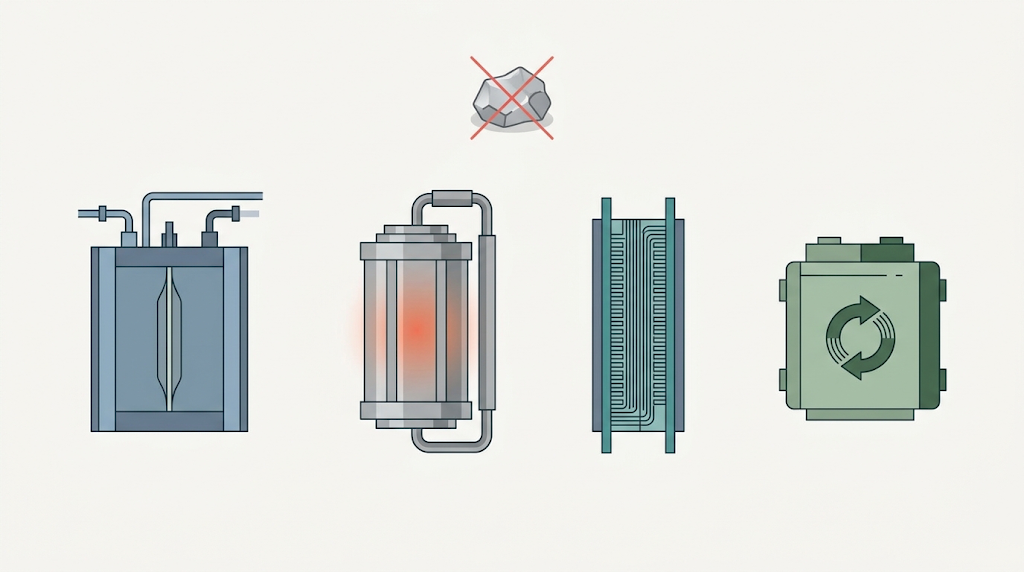
H2Pro, Sunfire, and Hysata all offer or develop electrolyzers without an iridium anode, and they differ in platinum content, published load behavior, and scale.
Four electrolyzer designs avoid iridium, and they differ more in load range and published evidence than in anything about the catalyst. This guide compares conventional alkaline, solid oxide, capillary-fed alkaline, and decoupled water electrolysis on materials, minimum load, efficiency, and scale, using vendor pages and published research. Where a figure is not published, the comparison says so.
What the iridium constraint looks like in numbers
The PEM anode runs in a strongly acidic environment, and iridium oxide is the catalyst that survives it for tens of thousands of hours. Wood Mackenzie describes typical PEM catalysts as about 65 percent iridium and 35 percent platinum, and no cheaper material has matched iridium oxide at commercial scale. The World Platinum Investment Council lists current loadings at 400 kilograms of iridium per gigawatt. It reports manufacturers pre-marketing 100 kilograms, Johnson Matthey calling 80 kilograms feasible by 2030, and Heraeus targeting 30 kilograms by 2050. Every PEM mitigation plan is therefore a thrifting plan, and a PEM supply agreement carries the loading roadmap as schedule risk.
For more on what drives the electricity bill in green hydrogen, see Electrolyzer Energy Use Compared: What Actually Cuts the Kilowatt-Hours?
Iridium supply: two forecasts compared
Iridium is a byproduct of platinum-group metal mining, so hydrogen demand has no direct lever on output. Wood Mackenzie puts production at about 7 tonnes a year, around 255,000 ounces, and cites US Geological Survey data attributing 87 percent of 2018 output to South Africa, 8 percent to Zimbabwe, and 3 percent each to Russia and Canada.
The 2026 Journal of Industrial Ecology study concludes that net-zero deployment would need roughly 30 percent of annual global iridium production and that shortages could arrive as early as 2030. The World Platinum Investment Council, a platinum industry body, reaches the opposite conclusion. It expects substitution in other industrial uses to free 45 to 67 thousand ounces a year, loadings to keep falling, and recycling to begin around 2030. Together those levers support about 1,550 gigawatts of cumulative PEM capacity by 2050, in its projection. Its own calculation shows the pressure: about 20 gigawatts of PEM planned for 2030 would consume roughly 250 thousand ounces, the entire annual supply, at today’s loadings.
Both positions require loadings to fall by a large factor. The disagreement is over execution speed, and a developer can price it by asking suppliers to quote a late-reduction case.
The four iridium-free designs
Each design removes iridium by a different route:
- Conventional alkaline separates the two gases with a diaphragm and runs both reactions at once.
- Solid oxide electrolyzes steam at about 800 degrees Celsius.
- Capillary-fed alkaline delivers water to the electrodes by capillary transport along a porous separator.
- Decoupled water electrolysis produces hydrogen and oxygen in separate time phases without a membrane.
Iridium-free describes only the anode catalyst. The capillary-fed cell in a 2022 Nature Communications paper pairs a nickel-iron anode with a platinum-on-carbon cathode, so platinum-group metals can remain in an iridium-free design. A buyer who wants a design with none needs to confirm anode and cathode materials with each vendor.
Do you know Which Electrolyzer Actually Cuts H2 Costs? Listen to the episode for a spoken comparison of electrolysis methods on cost.
The load-range cost of leaving iridium
Alkaline electrolysis was built for steady industrial power, and published research on dynamic electrolyzer operation puts its partial-load limit near 20 percent of nominal capacity, against roughly 5 percent for PEM. The diaphragm needs steady bubble production to keep the gases apart. At low current, hydrogen crosses toward the oxygen stream and the mixture approaches flammability, so operators shut down or vent.
Solid oxide has a different floor. One commercial module lists 50 to 100 percent load flexibility and 10 percent per minute ramping at about 800 degrees Celsius, so a solar hour below half the module’s rating falls outside the range.
A choice made on materials alone can arrive with a hidden battery, grid connection, or curtailment requirement. For an off-grid project that exchange is often worse than the iridium risk it replaced. The published evidence for the capillary-fed and decoupled designs is also narrower than for PEM.
H2Pro, Sunfire, and Hysata side by side
The table compares the three companies on six dimensions, with the source named in each cell.
| Dimension | H2Pro | Sunfire | Hysata | Why it matters |
|---|---|---|---|---|
| Iridium and platinum-group metals | Nickel-based electrodes, no platinum-group metals, no PFAS (H2Pro technology page) | No PEM-style iridium anode; product pages list no catalyst materials | NiFeOOH anode and Pt/C cathode at 0.5 mg Pt/cm² in the 2022 paper: iridium-free, not platinum-group-metal-free | Iridium exposure is a supply risk, and platinum exposure is a separate one |
| Operating principle | Decoupled water electrolysis: hydrogen and oxygen in separate time phases, no membrane, ambient temperature (H2Pro) | Pressurized alkaline at 30 bar(g); SOEC at about 800 °C on steam (Sunfire) | Alkaline capillary-fed cell; 27 wt% KOH and 85 °C in the paper | The principle sets the low-load limit and the balance of plant |
| Behavior under variable power | Instant on/off, no degradation penalty, lowest minimum working point in the industry (H2Pro); no percentage published | SOEC: 50-100% load range, 10%/min ramping (Sunfire); no range on the alkaline overview page | Hysata pages do not address variable power; paper: 39.4 to 42.2 kWh/kg from 0.294 to 1.0 A/cm² | Determines how much of a solar or wind profile the unit can use |
| Efficiency | No figure on the technology page | SOEC: 84% LHV (AC) proven with GEN 1 in 2022, 89% expected for GEN 3; alkaline stack: 67% LHV (DC) | 98% cell (40.4 kWh/kg) in the paper; 95% system (41.5 kWh/kg) per Hysata | Bases differ (LHV, HHV, cell, system), so the figures are not interchangeable |
| Scale and status | 0.5 MW pilot in Israel, about 200 kg/day; 5 MW planned in Extremadura, Spain, with 10 MWp of solar connected DC-to-DC (press release) | Standardized 10 MW SOEC module (291 kg/h); alkaline modules of 10 MW and 50 MW | Cell-level data in the paper; site lists partnerships with ACWA Power and POSCO | Unit size and operating hours indicate how much evidence exists outside the lab |
| Best fit | Direct solar or wind coupling, on pilot-scale evidence | Industrial sites with steam and steady power | Steady-load projects where energy per kg decides cost | Match to the project’s power profile |
On iridium the three are equivalent, since none depends on a PEM-style anode. Platinum content differs, because only H2Pro lists no platinum-group metals at all. Load behavior is where the published evidence differs most, and each company’s figures answer a different question.
How to choose for a directly coupled solar or wind project
The comparison does not produce a winner. Sunfire’s published load range is the most specific, Hysata’s cell data is the most detailed on efficiency, and H2Pro’s materials list is the shortest while its minimum-load figure is unpublished. A directly coupled project should request, in writing from every vendor, the iridium loading and platinum content of the quoted unit, the minimum stable load and cold-start time, and the count of validated on/off cycles.
FAQ
Q: Which electrolyzer designs avoid iridium?
A: Four designs avoid a PEM-style iridium anode: conventional alkaline, solid oxide, capillary-fed alkaline, and decoupled water electrolysis. They differ in platinum content, operating temperature, and published load behavior.
Q: What happens to an alkaline electrolyzer at low load?
A: Hydrogen crosses the diaphragm toward the oxygen stream because bubble production drops, and the mixture approaches flammability. Published research puts the alkaline partial-load limit near 20 percent of nominal capacity, so operators shut down or vent below it.
Q: How much of the world’s iridium would net-zero hydrogen need?
A: A 2026 Journal of Industrial Ecology study estimates roughly 30 percent of annual global production, with shortages possible from 2030. The World Platinum Investment Council disputes that and expects substitution, lower loadings, and recycling to balance the market.
Q: What is H2Pro’s decoupled water electrolysis?
A: H2Pro describes it as producing hydrogen and oxygen in separate time phases through a nickel redox cycle, with no membrane, at ambient temperature in plastic-based stacks. The electrodes are nickel-based with no platinum-group metals and no PFAS, per H2Pro’s technology page.
Q: Where does H2Pro operate its technology today?
A: H2Pro lists a 0.5 MW pilot in Israel producing about 200 kg of hydrogen per day, and its press release describes a 5 MW off-grid system planned in Extremadura, Spain, connected DC-to-DC to 10 MWp of solar. A later phase of 50 MW is also announced.
Q: How does H2Pro’s efficiency compare with Hysata’s published figures?
A: H2Pro’s technology page claims high efficiency at partial loads without giving a number. Hysata reports 98% cell efficiency at 40.4 kWh per kilogram in its published cell paper and 95% system efficiency at 41.5 kWh per kilogram on its site.