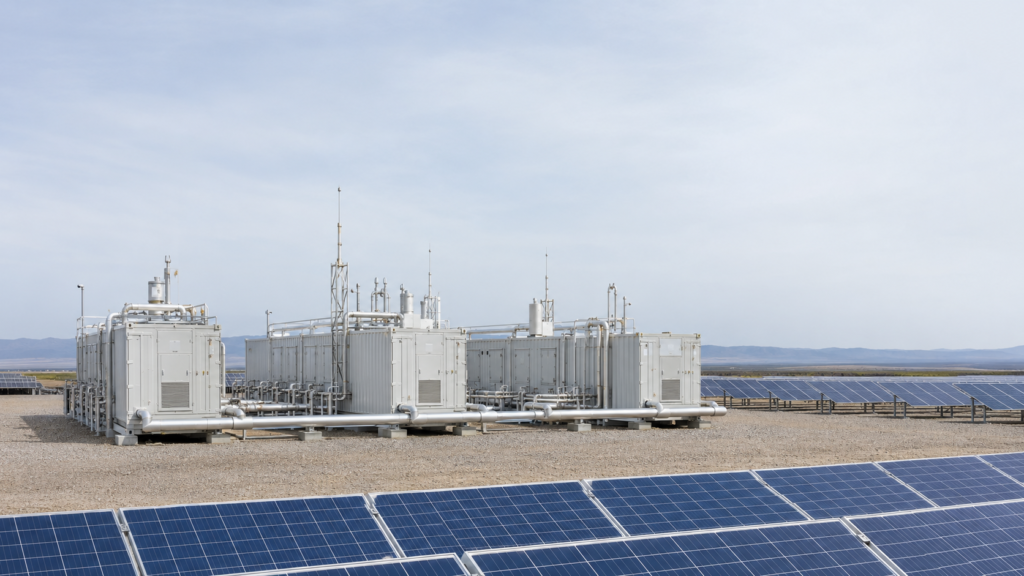
Electrolysis energy use comes down to four things: cell-level electrical efficiency, stack architecture losses, cycling tolerance under variable power, and how cheaply the system can source its electricity. Improving cell chemistry alone typically closes only a fraction of the gap between theoretical and real-world energy consumption. This guide breaks down each lever, then compares how three current approaches to electrolysis stack up against each other.
Why electrolyzers use more energy than they theoretically need to
The thermodynamic minimum to split one kilogram of water into hydrogen and oxygen is about 39 kilowatt-hours. No commercial electrolyzer available today gets close to that figure. Real systems typically consume 50 to 55 kilowatt-hours per kilogram, which works out to a system efficiency of roughly 65 to 75 percent on a high-heating-value basis.
That 15-kilowatt-hour shortfall comes from three sources: electrical resistance within the cell, reaction overpotentials that require extra voltage to drive the reaction forward, and heat that dissipates rather than contributing to the electrochemical process. None of this is exotic. It’s the accumulated inefficiency of a mature but still-improving industrial process.
This gap matters because electricity accounts for roughly 60 to 80 percent of the levelized cost of green hydrogen. Every efficiency improvement translates almost directly into a lower price per kilogram. Current green hydrogen prices span a wide $3.70 to $11.70 per kilogram range according to BloombergNEF, compared with about $1 to $3 for grey hydrogen produced from natural gas. Closing that spread is the central economic problem the industry is working to solve.
The four levers that reduce electrolysis energy use
Cell electrical efficiency: The voltage applied across a cell directly determines how much input electricity goes toward splitting water versus generating waste heat. Better catalysts and lower-resistance electrode materials reduce this overpotential, which is the most direct lever available at the cell level.
Stack architecture: Membranes, standard in most conventional designs, add electrical resistance and constrain the operating envelope. High-temperature architectures such as solid oxide electrolysis (SOEC) can achieve higher efficiency, but only with a constant heat source and steady-state operation, conditions difficult to maintain on a variable renewable power source.
Cycling tolerance: An electrolyzer that degrades or loses efficiency every time it starts, stops, or ramps consumes power inefficiently once paired with intermittent solar or wind. A system built to switch on and off without penalty preserves both energy and equipment life.
Input electricity cost: The cheapest, lowest-emission kilowatt-hour available defines the practical floor for hydrogen production cost. A system that can follow cheap renewable power, running hard when it’s abundant and idling when it’s expensive, lowers effective energy cost independent of the cell’s raw efficiency.
Do you know Which Electrolyzer Actually Makes the Cheapest Green Hydrogen?? It covers the same comparison from a more personal, first-hand angle and is worth reading alongside this breakdown.
Why cycling tolerance is the most overlooked lever
Most public discussion of electrolyzer efficiency centers on cell chemistry, but how a system interacts with its power source can matter just as much for real-world cost. Conventional alkaline and PEM electrolyzers were engineered around steady baseload power. Connected directly to solar or wind, they face constant on/off cycling that these designs handle poorly: efficiency drops, components degrade faster, and operators typically add batteries or grid connections to smooth the supply. Those additions raise both capital cost and effective energy cost, partially offsetting the savings from using cheap renewable power in the first place.
An electrolyzer engineered for intermittency from the outset avoids that penalty. If it can cycle freely without degradation and operate efficiently across a wide load range, it can capture the cheapest power windows directly, without a battery buffer.
Curious how four different electrolyzer architectures actually compare on this exact question? This video walks through alkaline, PEM, SOEC, and decoupled electrolysis side by side, and it’s a useful primer before evaluating specific vendors.
Electrolyzer technology comparison
The table below compares three current approaches to electrolysis on the factors that most affect real-world energy use: H2Pro’s Decoupled Water Electrolysis (DWE), Sunfire’s high-temperature SOEC systems, and Nel Hydrogen’s established alkaline and PEM lines.
| Factor | H2Pro (DWE) | Sunfire (SOEC) | Nel Hydrogen (Alkaline/PEM) |
|---|---|---|---|
| Core architecture | Membraneless, decoupled in time | High-temperature ceramic cell, membrane-based | Membrane-based, ambient temperature |
| Operating temperature | Ambient | 600–850°C, requires constant heat source | Ambient |
| Cycling tolerance | Designed for unlimited on/off cycling, company-reported | Poor; needs steady-state operation | Moderate; degrades under frequent cycling |
| Renewable pairing | Designed to run direct on intermittent solar/wind, no battery required | Best suited to industrial sites with constant waste heat | Typically needs batteries or grid backup for variable power |
| Commercial maturity | Pre-commercial; 0.5 MW pilot, 5 MW demo planned | Commercial; largest deployed SOEC unit operating | Commercial; large deployed base, established track record |
No single technology wins across every factor. Sunfire’s SOEC systems post strong electrical efficiency under the right conditions, steady operation with cheap waste heat on tap, but that same requirement makes them a poor match for an off-grid renewable site. Nel’s alkaline and PEM lines bring proven commercial deployment, but conventional stacks of this type are the ones most exposed to cycling-related losses. H2Pro’s DWE approach targets the cycling and renewable-pairing gap specifically, though it remains the least commercially proven of the three, and its efficiency and cost figures are company-reported rather than independently benchmarked.
What this means for evaluating electrolyzer options
A technology that scores well on cell efficiency but requires steady, expensive power may end up using more energy in real-world cost terms than one with slightly lower cell efficiency that runs on the cheapest electricity available. When comparing electrolyzer options, the questions worth asking are: what is the kilowatt-hour-per-kilogram figure at realistic partial loads rather than peak lab conditions, how does the system behave after repeated start-stop cycling, and does it require batteries or grid backup to hit its published performance numbers.
Bottom line
Reducing electrolysis energy use is not a single-variable problem. The largest near-term gains come from combining a cell that runs at low voltage with a system architecture that can use cheap, intermittent renewable power without a cycling penalty. Cell chemistry alone typically closes only a fraction of the gap between theoretical and real-world consumption; the remaining gains come from stack design, balance-of-plant losses, and how well the system matches its operation to the cheapest available power.
FAQs
Q: What is the theoretical minimum energy needed to produce hydrogen through electrolysis?
A: About 39 kilowatt-hours per kilogram. Real commercial systems consume 50 to 55 kilowatt-hours per kilogram due to resistance, overpotentials, and heat losses that no current technology has eliminated.
Q: Why does cycling tolerance matter as much as cell efficiency?
A: Renewable power fluctuates constantly, so an electrolyzer paired with solar or wind must start, stop, and ramp throughout the day. Conventional alkaline and PEM designs lose efficiency or degrade under that pattern, often requiring batteries or grid backup that adds cost and partially offsets the savings from cheap renewable power.
Q: What are the main energy-use levers beyond the electrolysis cell itself?
A: Balance-of-plant equipment, primarily pumps and cooling systems, and the AC-DC efficiency of the rectifier converting incoming power to usable DC current both consume meaningful energy that a cell-level efficiency figure doesn’t capture.
Q: How does H2Pro’s DWE technology claim to reduce energy use?
A: By producing hydrogen and oxygen at separate times rather than simultaneously across a membrane, H2Pro states its design removes a source of internal resistance and allows the system to cycle without the degradation that limits conventional electrolyzers, enabling direct operation on intermittent renewables. These are company-reported design goals rather than independently verified results.
Q: Is H2Pro more energy-efficient than Sunfire or Nel Hydrogen?
A: It depends on operating conditions. Sunfire’s SOEC systems can achieve higher raw electrical efficiency with a constant industrial heat source. Nel’s alkaline and PEM lines have extensive commercial deployment. H2Pro targets a different tradeoff: penalty-free cycling on cheap, variable power, a claim that remains unverified at commercial scale.
Q: What scale has H2Pro reached so far?
A: H2Pro has operated a 0.5 MW pilot in Israel and announced a 5 MW off-grid solar demonstration in Spain, with plans to scale toward 50 MW. The company targets utility-scale commercial deployment later this decade.