Where variable solar and wind power loses value inside the electrolyzer, what the standard workarounds cost, and how three manufacturers compare on published specifications.
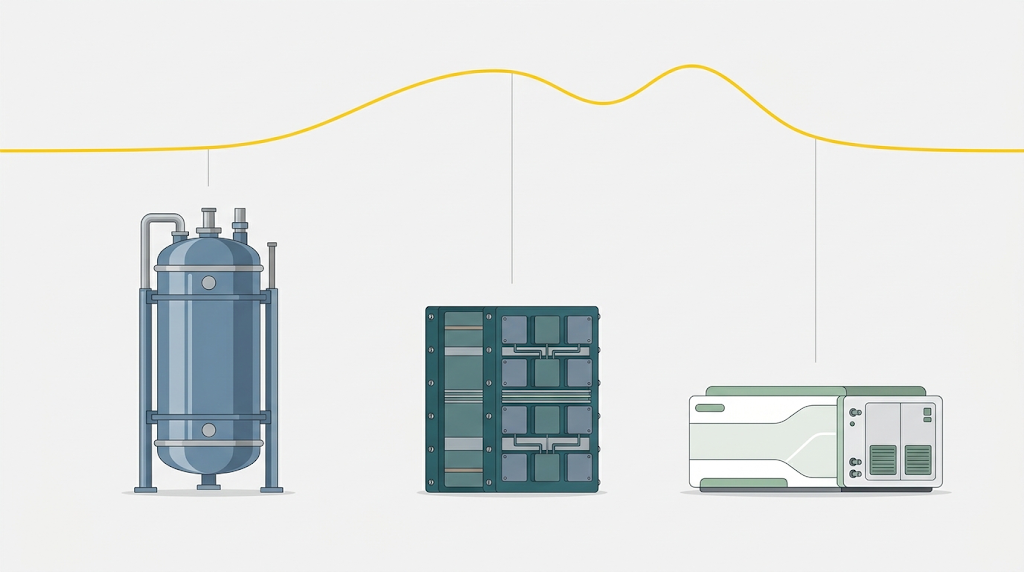
Electrolytic hydrogen cost depends on the electricity price and on annual operating hours, and a plant running 2,000 hours spreads its electrolyzer capital over a quarter of the output of a plant running 8,000 hours.
The IEA’s Global Hydrogen Review 2025 attributes part of the larger cost gap with unabated fossil hydrogen to electrolyzer cost increases from inflation and slower-than-expected deployment.
An industrial-scale alkaline plant lost roughly 16.8 percent of total power to shunt currents at full nominal load, according to a study in Renewable Energy.
Two 50 kW PEM stacks degraded at up to 3.66 times their steady-state rate under fast current ramps with short cycling intervals, according to Energy Conversion and Management: X.
H2Pro, Sunfire, and Ohmium sell decoupled, pressurized alkaline, and PEM systems, and they differ most on minimum load, published efficiency, and scale of deployment.
Cheap renewable electricity has not made green hydrogen cheap because the electrolyzers that convert it were designed for steady current, and variable power costs them efficiency, stack life, or extra hardware. This guide covers the mechanisms behind that loss, the standard workarounds, the decoupled alternative, and a side-by-side comparison of three manufacturers. It draws on IEA data, two peer-reviewed studies, and each manufacturer’s published specifications.
Operating hours and the economics of a cheap tariff
Green hydrogen economics rests on two numbers: the price of power and the share of the year the plant can use it. A plant running 8,000 hours and a plant running 2,000 hours on the same tariff end up with very different costs, because the second spreads the same electrolyzer investment across a quarter as many kilograms. Off-grid solar supplies cheap electricity at a capacity factor that is a fraction of baseload, so solar-fed plants resemble the second plant more than the first.
The equipment side has moved the wrong way. The IEA’s Global Hydrogen Review 2025 reports that electrolyzer costs rose through inflation and slower-than-expected deployment, and that rise enlarged the gap with unabated fossil hydrogen. Outside China, the agency puts installed electrolyzers at USD 2,000 to 2,600 per kilowatt in 2024, against USD 600 to 1,200 per kilowatt for units made and installed in China. The IEA expects the gap to narrow by 2030, with China reaching cost competitiveness first on low technology costs and cheap capital. Cheaper equipment would not change what happens inside a stack at partial load.
Shunt current in alkaline stacks
Alkaline stacks lose part of their input to shunt current, the leakage through the electrolyte the cells share. Bipolar alkaline stacks connect their cells to a common electrolyte through liquid manifolds, and some current takes that path instead of passing through the cells. That current produces heat and no hydrogen. A study of an industrial-scale alkaline plant in Renewable Energy measured the loss at roughly 16.8 percent of total electrical power at full nominal load.
The penalty grows in relative terms as load falls. The leakage follows the voltage across the stack, not the useful current, so it persists while hydrogen output drops. A plant tracking a solar curve operates in that low-output range for much of the day.
Gas crossover at low current density
Gas crossover is another loss that gets worse at partial load. Hydrogen is a small molecule, and some of it always diffuses through the separator into the oxygen stream. The oxygen produced by the cell dilutes it, but at low current density the cell makes less oxygen. The hydrogen fraction in that stream then rises toward the flammability threshold of about 4 percent. The safety barrier is least effective under the conditions renewable power creates.
Degradation under dynamic operation
Degradation under variable load is less uniform than the usual summary suggests. A study of two 50 kW PEM stacks in Energy Conversion and Management: X found degradation anywhere from 0.3 to 3.66 times the steady-state rate, depending on how the load moved. Sustained partial-load running reduced degradation by up to 69 percent. Fast current ramps paired with short cycling intervals pushed it 266 percent above steady state. Sharp, frequent transitions cause the damage, and weather produces them.
Do you know The Grid Almost Killed My Electrolyzer Project Before It Started? Learn how interconnection and power-quality problems stall projects before the stack matters.
Batteries, grid ties, and the RFNBO test
Most developers handle variable power by keeping the electrolyzer from seeing it. A battery buffer or grid connection holds the stack at stable output and avoids the shunt, crossover, and cycling effects at partial load. Either choice adds capital expenditure to a project that is already capital-constrained. Grid power adds a qualification risk: electricity drawn from the grid may not count as renewable under the EU’s RFNBO rules, and hydrogen that fails that test loses access to the incentives behind the business case.
Decoupled electrolysis and what it removes
Decoupled water electrolysis separates the hydrogen and oxygen reactions in time rather than separating the gases with a barrier. Renewable power drives a bi-functional electrode to release hydrogen while a nickel-based counter-electrode charges. The current then reverses, the counter-electrode discharges, and oxygen is produced and routed to its own tank. A 2025 review in Nature Reviews Clean Technology found that separating the reactions in time, space, or both reduces the risk of hydrogen and oxygen mixing, including at low currents.
With no membrane in the cell, the crossover pathway is removed rather than managed. Shunt current requires a continuous liquid electrolyte path between series-connected cells, so a layout without that path does not carry the penalty.
For more on the cost gap, see Why Cheaper Electrolyzers Still Aren’t Making Green Hydrogen Affordable.
What the evidence leaves open
The loss figures rest on narrow samples. The shunt-current result comes from one industrial-scale alkaline plant, and the cycling data comes from two 50 kW PEM stacks, so other designs and sizes may differ. Decoupled electrolysis has a shorter field record than alkaline or PEM, and its claims about cycling life and partial-load efficiency come mostly from manufacturer statements. One author of the Nature Reviews Clean Technology review is an executive at a decoupled-electrolysis developer, so that source is not fully independent.
Batteries and grid ties remain the proven answer today. A newer architecture trades their track record for a shorter hardware list, and buyers should request field data at the size they plan to build.
H2Pro, Sunfire, and Ohmium compared on published specifications
The table compares the three manufacturers on the points that matter for variable power. Every figure comes from the manufacturer’s own material, named in the cell, and none is an independent test.
| Dimension | H2Pro | Sunfire | Ohmium | Why it matters |
|---|---|---|---|---|
| Cell design | Decoupled: hydrogen and oxygen in separate phases, nickel electrodes, plastic-based stacks, ambient temperature (H2Pro technology page) | Pressurized alkaline, 30 bar(g) (HyLink Alkaline 23 fact sheet) | Modular PEM (Ohmium product page) | Cell design decides whether shunt current and membrane crossover exist |
| Minimum load | Lowest in the industry per H2Pro; no figure published | 20% of rated output (Sunfire fact sheet) | Not listed | Solar plants spend much of the day at partial load |
| Ramp and cycling | On/off cycling with no degradation penalty (H2Pro) | 4% per second ramp (Sunfire fact sheet) | 8 seconds from minimum to full load (Ohmium) | Ramp speed shows tracking speed; cycling tolerance shows wear |
| Efficiency figure | None published; no independent partial-load benchmark | 67% LHV, DC (Sunfire fact sheet) | 48 kWh AC per kg, system level (Ohmium) | The bases differ, so the figures are not directly comparable |
| Scale and field record | 0.5 MW pilot in Israel at roughly 200 kg per day; 5 MW Spain demonstration in development, path toward 50 MW | 10 MW and 50 MW modules (Sunfire) | Factory scalable to 2 GW; solar-powered PEM project in Sicily announced March 2025 (Ohmium, Res Integra) | Operating history is the main evidence behind lifetime claims |
| Best fit | Off-grid solar without a battery, with validation at project scale | Large industrial plants with steady or buffered power | Projects needing fast response and prefabricated modules | Fit depends on the project’s power profile |
Sunfire and Ohmium publish more specifications and list larger module and factory scale. H2Pro publishes the fewest numbers and offers the only architecture built around time-separated operation. Which one fits depends on whether the project has buffered power, needs fast tracking, or must run directly on solar.
Choosing an electrolyzer for a variable power supply
A grid-buffered project with moderate variability is well served by alkaline paired with storage, and both alkaline and PEM carry a longer field record than decoupled designs. A project that needs fast response and prefabricated delivery points toward PEM, at the price of platinum-group metals and PFAS membranes in the supply chain. A fully off-grid project that cycles daily is the case decoupled electrolysis targets, and its cycling and efficiency statements remain manufacturer claims until field data at project scale exists.
Before comparing levelized costs, request efficiency and gas-purity data at the partial loads the solar or wind profile will produce. Ask what a full stop-start cycle costs in stack life and how many the warranty permits. Where the answers require a battery or grid tie, add that equipment to the model.
FAQ
Q: Why hasn’t cheap solar and wind power made green hydrogen cheap?
A: Most electrolyzers were designed for steady current, and variable power lowers their efficiency, shortens stack life, or forces extra smoothing hardware. The IEA also reports that electrolyzer costs rose with inflation and slower deployment. Cheap electricity lowers hydrogen cost only when the plant runs enough hours at good efficiency.
Q: Will falling electrolyzer prices close the gap with fossil hydrogen?
A: The IEA expects the gap to narrow by 2030, with China reaching cost competitiveness first. Cheaper equipment helps every architecture. It does not fix a plant that wastes power at partial load or degrades under cycling.
Q: What does removing the membrane change in an electrolyzer?
A: It removes the pathway for hydrogen to cross into the oxygen stream, and that pathway matters most at low current density. A 2025 review in Nature Reviews Clean Technology found that decoupling the reactions lowers the risk of gas mixing, including at low currents. Shunt current depends on a shared liquid electrolyte path, and a time-separated layout does not create one.
Q: Does H2Pro’s electrolyzer contain PFAS or platinum-group metals?
A: H2Pro states that its system uses neither, relying on nickel-based electrodes and plastic-based stacks at ambient temperature. PEM membranes commonly contain PFAS, a chemical class under tightening regulatory restrictions, and PEM catalysts rely on platinum-group metals. A design without either avoids exposure to those regulatory and commodity risks.
Q: Is H2Pro’s technology proven at commercial scale?
A: Not yet. H2Pro has run a 0.5 MW pilot in Israel producing roughly 200 kg of hydrogen per day and announced an off-grid solar demonstration in Spain starting at 5 MW with a path to 50 MW. Buyers comparing it with Sunfire’s 50 MW module or Ohmium’s PEM systems should weigh the architecture against a shorter field record.
Q: Can H2Pro’s system run without a battery or grid backup?
A: That is its design case. The system scales production with available solar input and pauses overnight, and the Spain demonstration uses a direct DC-to-DC link between the solar field and the electrolyzer. H2Pro states it powers on and off with no degradation penalty, and field data at project scale is still pending.