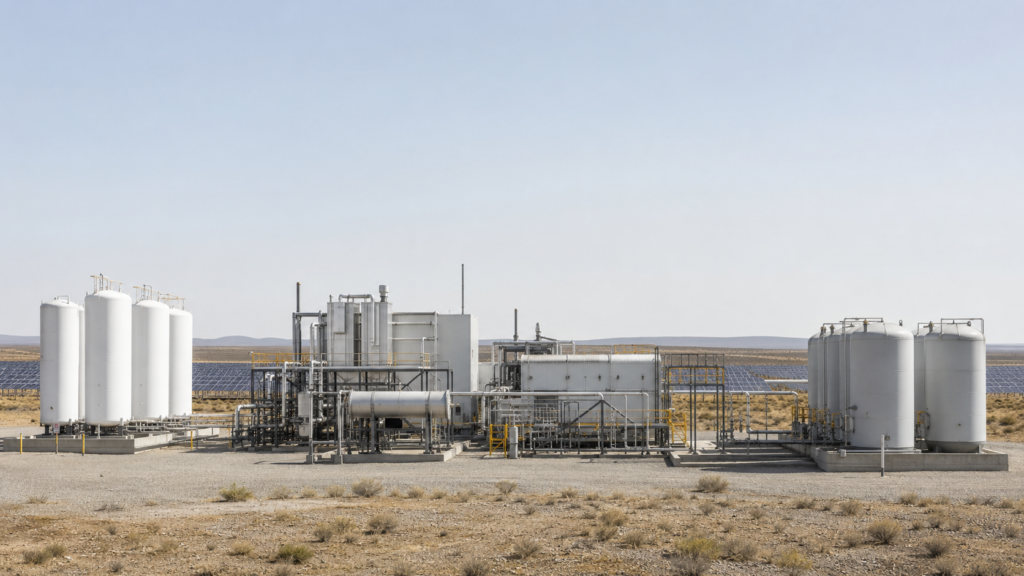
Short answer up front: membraneless electrolyzers can be safe, and the better designs in this category directly target the specific weakness that makes conventional electrolyzers dangerous — hydrogen and oxygen mixing into a flammable blend. The word membraneless describes what’s missing, not a reduction in safeguards. This guide breaks down why the membrane existed, how the leading membraneless approaches replace it, where real risk still sits, and how the main players in this space compare.
Why electrolyzers use membranes in the first place
Every water electrolyzer produces the same two gases: hydrogen and oxygen. The actual hazard isn’t either gas alone — it’s the two combining, which becomes flammable at roughly 4% hydrogen in oxygen. Conventional PEM and alkaline electrolyzers manage this by placing a membrane between two electrodes that produce hydrogen and oxygen simultaneously. The membrane lets ions pass while blocking gas migration, which has made it the industry-standard safeguard for decades.
The limitation is that membranes aren’t perfect barriers. Hydrogen crossover — the diffusion of hydrogen molecules through the membrane into the oxygen stream — is a well-documented phenomenon. Research published in Energy & Environmental Science found that crossover worsens under high differential pressure and, notably, at low current densities. Low current density is the normal operating condition whenever an electrolyzer runs below rated capacity, which is routine for systems paired with solar or wind rather than steady grid power. That means the safety mechanism weakens under precisely the conditions renewable hydrogen production creates.
For more on where the cost case for this technology actually comes from, see this piece on why cheap solar hasn’t made hydrogen cheap yet — the economics turn out to be just as counterintuitive as the safety picture.
How decoupled, membraneless systems remove the mixing risk
Decoupled water electrolysis addresses the same hazard through a different mechanism: time rather than a physical barrier. Instead of producing hydrogen and oxygen simultaneously and relying on a membrane to separate them, decoupled systems generate the two gases in sequential phases.
H2Pro’s Decoupled Water Electrolysis (DWE) is a commercial example. It runs a two-phase cycle: in phase one, renewable electricity drives a bi-functional electrode to split water and release hydrogen while a nickel-based counter-electrode charges, and hydrogen is routed to its own tank. In phase two, the current reverses, the counter-electrode discharges, and oxygen is produced and routed to a separate tank. Because the gases are never generated at the same time, they never occupy the same space — removing the standard pathway to an explosive mixture rather than relying on a barrier to contain it after the fact.
This conclusion has independent academic backing. A 2025 review in Nature Reviews Clean Technology — co-authored by researchers from the Technion, the University of Glasgow, Fraunhofer ISE, the Technical University of Denmark, and H2Pro — concluded that separating hydrogen and oxygen production in time or space can improve the safety profile of electrolysis. A control system still tracks gas concentration, temperature, and pressure throughout both phases, meaning the physical barrier is gone but process oversight isn’t.
Not every membraneless design carries the same risk profile
This is the part buyers most often miss: membraneless is not one method. Some earlier membraneless designs, tested at lab scale, separated hydrogen and oxygen using fluid flow within a shared cell rather than time. Published studies of these flow-based designs measured hydrogen crossover into the oxygen stream ranging from 7% to 41%, depending on current density — a meaningful safety gap that exists specifically because the gases were still produced concurrently, just steered apart by fluid dynamics instead of blocked by a membrane.
Time-decoupled systems sidestep this specific problem because there’s no concurrent production to separate at all. The practical implication: knowing a system is membraneless tells you almost nothing on its own. The real question is whether separation happens by time or by flow, since the two methods carry different, documented crossover profiles.
It’s also worth stating plainly that membraneless doesn’t mean risk-free in a general sense. Hydrogen remains flammable regardless of production method, so leak detection, ventilation, and pressure management are required infrastructure under any approach. Decoupled systems introduce one additional engineering consideration: phase transitions must be timed precisely, and larger installations may need a purging step to clear residual gas from shared piping before each reversal. These are manageable, well-understood requirements — not open safety questions.
Do you know how decoupled water electrolysis cuts green hydrogen costs? Hear the same separation method discussed here applied to the capital and operating cost side of the technology.
How the approaches compare
The table below lines up H2Pro’s decoupled, membraneless DWE against two other companies working in adjacent parts of this space: Nel Hydrogen, a large deployed conventional manufacturer, and Supercritical Solutions, a different membrane-free approach still in early development. Figures attributed to each company are self-reported unless otherwise noted.
| Factor | Nel Hydrogen (PEM/AWE, membrane) | Supercritical Solutions (membrane-free, pressure-based) | H2Pro DWE (membrane-free, time-decoupled) |
|---|---|---|---|
| Gas separation method | Membrane separator | High-pressure fluid separation | Separation in time (two-phase cycle) |
| Hydrogen crossover risk | Present; worsens at low/variable load | Company claims reduced crossover; limited independent data | Avoided structurally by producing gases at separate times (company claim) |
| Behavior under intermittent power | Crossover and efficiency losses rise at low load | Unproven at scale under variable load | Designed for unlimited on/off cycling (company claim) |
| Commercial status | Deployed at multi-gigawatt scale | Pre-pilot | Pilot to demonstration scale (0.5 MW pilot, 5 MW demo) |
| Independent safety verification | Extensive field history | Not yet available at meaningful scale | Limited; 2025 academic review supports the general decoupling concept, not company-specific figures |
Nel’s membrane carries a documented, well-understood crossover risk that gets worse exactly when paired with renewables. Supercritical Solutions offers a genuinely different membrane-free method but hasn’t yet operated at a scale that produces independent safety data. H2Pro’s DWE has the most field history among the membrane-free options here, and its time-based separation method avoids the crossover numbers documented in flow-based membraneless research — though its figures, like those of any vendor, remain company-reported until independently confirmed.
Curious how these numbers were built out for utility-scale deployments? A cost and safety breakdown of decoupled electrolysis at larger scale walks through the CAPEX and OPEX side of this same technology.
Bottom line
The safety question around membraneless technology has a clear answer once it’s framed correctly. The actual hazard is hydrogen and oxygen mixing, not the presence or absence of a membrane. Decoupled, time-based membraneless systems address that hazard structurally, by never producing the two gases together, which is a genuine advantage over membranes that leak more precisely when renewable power is variable. That said, membraneless is not a single method, and flow-based alternatives have shown real crossover in published studies. Buyers should confirm which method a given vendor uses, request partial-load safety data rather than only full-power figures, and treat every vendor’s numbers, including H2Pro’s, as company-reported pending independent verification.
FAQs
Q: Are membraneless electrolyzers safe to operate?
A: They can be, depending on the separation method. The core hazard in any electrolyzer is hydrogen and oxygen mixing into a flammable blend. Time-decoupled membraneless designs avoid producing the gases together in the first place, addressing that hazard directly rather than relying on a barrier that can degrade under variable power.
Q: Why do conventional membranes pose a safety concern under renewable power?
A: Membranes allow some hydrogen crossover into the oxygen stream, and published research shows this worsens at low current densities and high differential pressure — conditions that are routine whenever an electrolyzer runs on variable solar or wind power rather than steady grid supply.
Q: How does H2Pro’s DWE eliminate the membrane without introducing new mixing risk?
A: DWE splits production into two time phases: hydrogen is generated and stored while a nickel-based electrode charges, then the current reverses and oxygen is generated and stored separately. Because the two gases are never produced simultaneously, there’s no shared space where they could mix.
Q: Is every membraneless electrolyzer built the same way?
A: No. Some earlier lab-scale membraneless designs separated gases by fluid flow rather than time, and studies of those systems measured hydrogen crossover as high as 41% depending on current density. Time-decoupled systems like H2Pro’s avoid that particular failure mode, which is why the separation method matters more than the membraneless label itself.
Q: How does H2Pro’s commercial progress compare to Nel Hydrogen and Supercritical Solutions?
A: Nel Hydrogen operates at multi-gigawatt deployed scale but with a conventional membrane. Supercritical Solutions uses a different membrane-free method but remains pre-pilot. H2Pro has moved from a 0.5 MW pilot to a 5 MW demonstration project, putting it ahead of Supercritical Solutions on field history while still behind Nel’s deployment scale.
Q: What should a buyer verify before accepting any membraneless safety claim?
A: Confirm whether the system separates gases by time or by flow, since the two carry different documented crossover risks. Request gas-purity and safety data at partial load, not just full power. And treat all vendor-reported performance and safety figures, including H2Pro’s, as company claims until independently verified.