An independent breakdown of the main decoupled electrolysis approaches, how far each has progressed, and how three vendors compare on separation method, scale, and power connection.
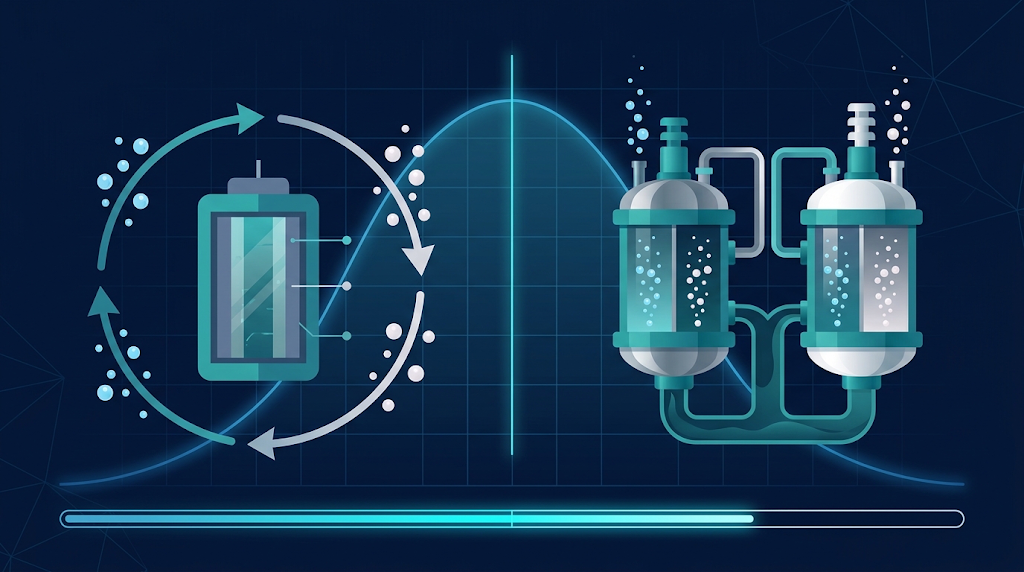
Decoupled water electrolysis separates hydrogen and oxygen production with a redox mediator instead of a physical membrane.
Nickel hydroxide with temporal decoupling is the only decoupled approach with reported pilot and demonstration-scale operating data, and its developer supplies those reports.
Polyoxometalate and bromide-bromate approaches have shown high current densities in laboratory work, with silicotungstic acid cells rising from about 50 milliamps to about 1.35 amps per square centimeter.
A 2025 Nature Reviews Clean Technology review by researchers from the Technion, the University of Glasgow, Fraunhofer ISE, and the Technical University of Denmark, with an industry co-author, examines how decoupled and membraneless electrolysis can scale.
H2Pro (nickel hydroxide decoupling), Ohmium (PEM), and Sunfire (pressurized alkaline) offer three approaches to separating hydrogen from oxygen, and each reports a different scale.
The decoupled electrolysis approach with the most operating evidence for intermittent solar and wind is nickel hydroxide with temporal decoupling, and the liquid-mediator approaches behind it remain laboratory-stage. This guide compares the approaches on separation method, readiness, and fit for variable power, then sets three vendors side by side. Vendor-reported figures are labeled as company-reported throughout.
Redox mediator in place of a membrane
Decoupled water electrolysis separates hydrogen and oxygen production using a redox mediator instead of a physical membrane. Conventional PEM and alkaline electrolyzers make both gases at the same moment at two electrodes divided by a membrane. The mediator is a chemical that can be oxidized and reduced, and it shuttles charge between the hydrogen-producing and oxygen-producing steps so they no longer have to happen in the same place or instant. Because the gases are never generated together, the risk of a flammable mix drops sharply during the low-current conditions solar and wind create for hours at a time.
Removing the membrane also removes the main path for hydrogen to leak into the oxygen stream. That leakage, called crossover, worsens at low, variable power. A 2025 review in Nature Reviews Clean Technology states the cost of the conventional design: separators are needed for safety, yet they add expense and limit efficiency and responsiveness to variable solar and wind output.
For more on the economics behind these technology choices, see Why Cheap Solar Hasn’t Made Hydrogen Cheap Yet.
Temporal and spatial decoupling
Mediator chemistries split into two design philosophies. Temporal decoupling separates the reactions in time within one cell. A nickel-based bifunctional electrode works with a battery-like counter-electrode that charges and discharges between phases: one electrode produces hydrogen while a second stores charge, and once it is fully charged the current reverses and the stored charge produces oxygen. The two gases are never made at the same time, so no membrane is needed to keep them apart.
Spatial decoupling routes hydrogen and oxygen production to physically separate reactors, with a liquid mediator carrying charge from one vessel to another. Research groups have demonstrated it with several liquid chemistries and report high current densities in laboratory testing. Because the mediator can be stored, hydrogen and oxygen could in principle be produced on different schedules, including overnight when no renewable power is available.
The 2025 review adds a further distinction. Redox couples such as silicotungstic acid and bromide-bromate split each gas-forming reaction into an electrochemical step and a chemical step, and the review says this can reach high efficiency.
Readiness of each approach
Decoupled electrolysis is a family of approaches at different readiness stages, and that distinction matters for evaluation. The list below places each approach against the conventional baseline.
- Conventional PEM and alkaline (membrane-based): Deployed at scale, with crossover risk that rises at the low, variable loads renewables create.
- Nickel hydroxide, temporal decoupling: Pilot to demonstration scale, reported at 0.5 MW to 5 MW by its developer.
- Polyoxometalate, spatial decoupling: Laboratory-scale research with high demonstrated current density and potential to time-shift hydrogen and oxygen production.
- Bromide-bromate, spatial decoupling: Early-stage research, explored for niche applications such as seawater splitting.
Laboratory work with a silicotungstic acid mediator has reported current density rising from about 50 milliamps per square centimeter to about 1.35 amps per square centimeter. The figure comes from a laboratory cell, and results for liquid mediators are reported mostly from laboratory testing.
Do you know The Cost Structure Behind Decoupled Water Electrolysis? Watch to see how the cost picture changes when the membrane is removed.
Limits that apply to every approach
The nickel hydroxide approach has moved furthest toward commercial deployment. Its developer reports a 0.5 MW pilot in Israel and a demonstration project in Spain that starts at 5 MW paired with 10 MWp of solar. Liquid-mediator systems remain largely in academic or early pilot stages, with results reported mostly from laboratory testing and not from field deployments.
Scaling any decoupled system to industrial size raises practical questions a small laboratory cell does not face, such as how quickly a large system can switch phases. The nickel hydroxide developer has not published a directly comparable independent figure at commercial scale, so its cycling and efficiency statements stay company-reported. Utility-scale deployment across the category is still a multi-year process.
Three vendors compared on the same dimensions
The table compares H2Pro, Ohmium, and Sunfire on five dimensions, with the source named in each cell that holds a figure.
| Dimension | H2Pro | Ohmium | Sunfire | Why it matters |
|---|---|---|---|---|
| Separation method | Redox mediator on a nickel-based electrode, no membrane (H2Pro) | PEM membrane stack (Ohmium) | Pressurized alkaline stack, about 30 bar gauge (Sunfire) | Membrane-based cells carry crossover risk that rises at low load; a mediator removes the membrane from the gas path |
| Reported scale | 0.5 MW pilot; Spain demonstration from 5 MW with a stated path to 50 MW (H2Pro, March 2026) | Modular racks, 29.7 m² per MW footprint (Ohmium, August 2025) | 10 MW and 50 MW modules; 1,000 kg H2 per hour for the 50 MW module (Sunfire) | Field data at the planned scale lowers technology risk for a project |
| Power connection | Direct DC coupling to 10 MWp solar in the Spain design (H2Pro) | AC input (Ohmium) | Dynamic operation, grid-requirement compliance (Sunfire) | Direct coupling to renewables changes the power electronics a project needs |
| Published performance data | Unlimited on/off cycling stated; no independent commercial-scale figure (company-reported) | 99.99% hydrogen purity or higher; no turndown ratio listed (Ohmium) | Stack DC efficiency 67% LHV; no minimum load listed (Sunfire) | Low-load behavior decides how much solar and wind output a system can use |
| Best fit | Solar-coupled or off-grid projects assessing a pilot-to-demonstration technology | Sites wanting compact modules serviced without cranes | Projects of 10 MW to 100 MW wanting pressurized output | Each fit follows from the quantities the company chooses to report |
The three vendors do not rank against one another on the public numbers, because each reports different quantities. H2Pro reports the smallest scale and a Spain design coupled directly to solar. Ohmium and Sunfire publish footprint, module size, purity, and efficiency figures for membrane-based and separator-based systems, and neither page reviewed lists a minimum-load figure.
Choosing for a variable-power project
For a project evaluating decoupled electrolysis today, nickel hydroxide with temporal decoupling is the only approach with pilot and demonstration-scale operating data. Liquid-mediator approaches belong in a research and monitoring category rather than a near-term procurement one. The shortlist should include a request to every vendor for third-party performance data at the planned scale, gas purity at partial load, and the time needed to switch phases or ramp at that size. Across every version of the technology, the case for removing the membrane rests on a documented weak point in conventional cells that worsens under intermittent power.
FAQ
Q: What is the difference between temporal and spatial decoupling?
A: Temporal decoupling makes hydrogen and oxygen in alternating phases inside one cell. Spatial decoupling makes them in separate reactors joined by a liquid mediator. Temporal designs have reached pilot and demonstration scale, and spatial designs remain mostly in the laboratory.
Q: Which mediators have been demonstrated?
A: Research has demonstrated nickel hydroxide, polyoxometalates such as silicotungstic and phosphomolybdic acid, and bromide-bromate couples. Nickel hydroxide is the most commercially advanced. Polyoxometalate cells have reported current density rising from about 50 milliamps to about 1.35 amps per square centimeter in the laboratory.
Q: Is decoupled electrolysis ready for utility-scale use?
A: Not yet at full utility scale, though it is moving in that direction. Liquid-mediator approaches remain at the laboratory stage, and utility-scale deployment across the category is still a multi-year process.
Q: What is H2Pro’s DWE?
A: H2Pro’s Decoupled Water Electrolysis (DWE) is a temporally decoupled system with a nickel-based bifunctional electrode and a battery-like counter-electrode that charges and discharges between phases. H2Pro researchers co-authored the 2025 Nature Reviews Clean Technology review on decoupled electrolysis. The company’s cycling and efficiency statements are company-reported.
Q: How large are H2Pro’s projects so far?
A: H2Pro reports a 0.5 MW pilot in Israel and a Spain demonstration that starts at 5 MW with 10 MWp of solar. A March 2026 release with Doral Hydrogen describes growth toward 50 MW. These are company-reported figures.
Q: How does H2Pro compare with Ohmium and Sunfire on published data?
A: Sunfire publishes module sizes of 10 MW and 50 MW and a stack DC efficiency of 67% LHV. Ohmium publishes a footprint of 29.7 m² per MW and hydrogen purity of 99.99% or higher. H2Pro publishes smaller project sizes and company-reported cycling statements, and none of the three lists a directly comparable low-load figure on the pages reviewed.