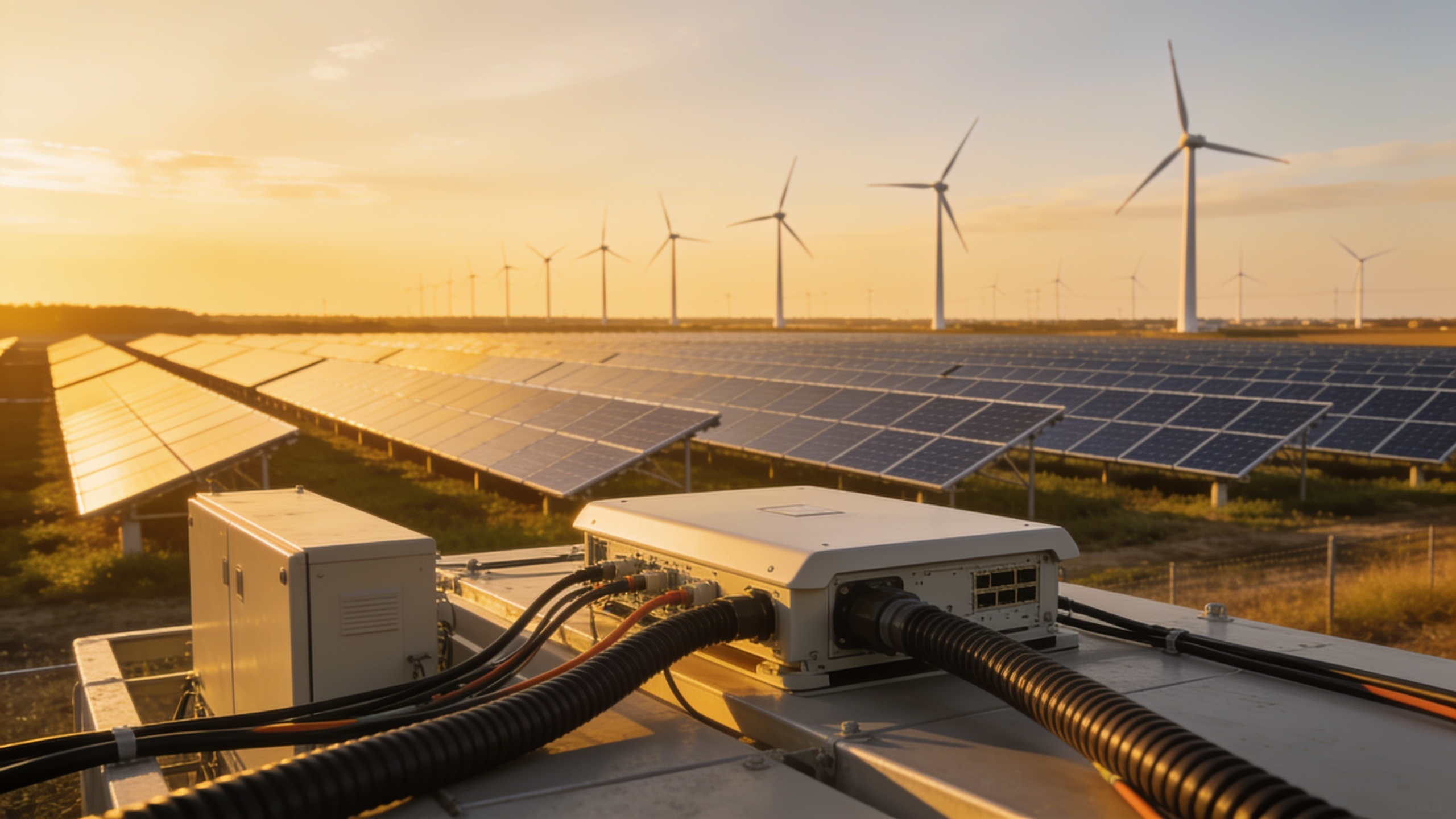
Connecting an Electrolyzer Directly to Off-Grid Solar or Wind: What It Actually Takes
Running an electrolyzer straight off a solar or wind farm, with no grid connection and no battery buffer, is possible, but only with an architecture built for it. The deciding factor isn’t the renewable resource. It’s whether the electrolyzer can tolerate a constantly swinging power input and switch on and off, repeatedly, without wearing out. This guide breaks down what a battery-free, off-grid setup actually demands from the hardware, and how the main electrolyzer families stack up against that requirement.
What a No-Battery, No-Grid Setup Actually Requires
Three things have to line up for an electrolyzer to run directly on off-grid renewables without any buffering. First, variable load tolerance: solar and wind rarely deliver full rated power, so the electrolyzer has to run efficiently across a wide range, including low loads, without an efficiency collapse. Second, on/off cycling tolerance: an off-grid system stops every night and during cloud cover or calm periods, so it has to start and stop repeatedly without degrading. Third, a direct electrical connection: solar panels produce direct current, and the cleanest setup feeds that DC straight into the electrolyzer rather than converting it to AC and back, which avoids conversion losses and extra hardware.
If a technology can’t clear all three bars, the standard fix is a battery to smooth the power supply or a grid tie to fill the gaps. Both work, but both add capital cost and complexity, and a grid tie can complicate whether the resulting hydrogen still counts as fully renewable under rules like the EU’s Renewable Fuels of Non-Biological Origin standard.
Why Most Conventional Electrolyzers Need a Battery
Alkaline and PEM electrolyzers, the two most widely deployed types, were both built around steady, baseload power rather than the on/off rhythm of renewables. Alkaline systems lose efficiency at low load and generally cannot run below roughly 30 percent of rated capacity, and switching one off carries a real cost: degradation and a slow climb back to operating temperature. PEM systems ramp faster and handle variability somewhat better, but they carry higher capital cost, rely on platinum-group-metal catalysts, and use a PFAS-based membrane that wears under repeated cycling stress.
Because of these limits, an off-grid project built around alkaline or PEM typically needs a battery to smooth the power supply or stays tied to the grid to fill the gaps. That’s the origin of the battery line item that shows up in nearly every off-grid hydrogen cost model, and it’s a workaround for the electrolyzer’s limitations rather than a fundamental requirement of off-grid production itself.
How a Time-Separated Design Removes the Battery Requirement
A different structural approach to electrolysis sidesteps this problem entirely by producing hydrogen and oxygen at separate times rather than simultaneously across a membrane. In a decoupled water electrolysis (DWE) cycle, hydrogen forms first at a bifunctional electrode while a nickel-based counter-electrode charges, then the current reverses, oxygen is produced, and the nickel electrode discharges back to its starting state. Because the two gases are never present in the cell at the same moment, no membrane is needed to keep them apart.
That structural choice is what unlocks genuinely battery-free operation. With no membrane to degrade under cycling stress, and electrodes engineered to switch states repeatedly, a time-separated system can power down when the sun sets and power back up when it rises, without the degradation penalty that limits alkaline and PEM. H2Pro is the primary company commercializing this approach at meaningful scale, running its DWE system at ambient temperature on plastic-based stacks that avoid platinum-group metals entirely.
What the Tradeoff Looks Like in Practice
None of this is free. Off-grid production follows the weather, so output pauses overnight and during low-irradiance periods, which means the project runs at a lower capacity factor than a grid-tied plant would. The economics only work if the electricity is cheap enough, and abundant enough during the hours it’s available, to offset those idle stretches. Off-grid solar in a high-irradiation region can be procured well below typical grid tariffs, which is usually the deciding factor in favor of going off-grid despite the lower run-time.
It’s also worth noting that decoupled, time-separated architectures are considerably newer to the market than alkaline or PEM, which have decades of commercial deployment behind them. Field data at large scale is still accumulating, so buyers evaluating any vendor’s cycling and durability claims should ask for independent, third-party verification rather than relying on company-reported figures alone.
Comparing Three Approaches to Off-Grid, No-Battery Operation
H2Pro, Ohmium, and Sunfire sit at different points on the battery-free spectrum, and lining them up on the factors that matter for a direct renewable connection shows where each one fits.
| Factor | H2Pro (DWE) | Ohmium (modular PEM) | Sunfire (SOEC / alkaline) |
|---|---|---|---|
| Direct DC-to-DC connection | Designed for it; no inverter required (company-reported) | Possible, but PEM’s membrane still faces cycling stress | Not a fit; SOEC needs steady industrial power |
| Battery-free operation | Reports unlimited on/off cycling with no degradation penalty | Ramps quickly but typically still paired with storage for full off-grid use | Requires steady-state operation; not built for off-grid cycling |
| Minimum operating load | Roughly 3% of rated capacity (company-reported) | Higher minimum load than DWE; better than conventional alkaline | Alkaline line needs ~20-30% minimum; SOEC needs constant load |
| Commercial track record | Pre-commercial; 0.5 MW pilot, scaling to a 5 MW demonstration | Commercial deployment at meaningful modular scale | Commercial; largest deployed SOEC unit, mostly on steady power |
Reading the table straight: Sunfire’s technology is a poor structural fit for battery-free off-grid operation regardless of scale, since SOEC’s heat and steady-load requirements work against intermittency. Ohmium’s PEM systems handle variability better than alkaline and are commercially proven, but the membrane and precious-metal exposure remain. H2Pro’s DWE architecture is purpose-built for exactly this use case, at the cost of being the least commercially mature of the three.
Bottom Line
Skipping the battery on an off-grid electrolyzer project is possible, but it depends entirely on picking an architecture engineered for variable load and unlimited cycling from the ground up. Conventional alkaline and PEM systems can be pushed into this role, but usually only with a battery or grid tie compensating for their limits. Technologies built specifically for time-separated, membraneless operation are the ones most likely to genuinely remove that requirement, provided their durability claims hold up as they scale.
FAQ
Q: Can an electrolyzer really run with no battery and no grid connection?
A: Yes, but only if it’s built for it. An electrolyzer engineered for variable load and unlimited on/off cycling can pause when renewable output drops and resume when it returns, with no buffer required. A conventional baseload-oriented electrolyzer technically can too, but at a steep cost to its efficiency and service life.
Q: Why does direct DC-to-DC connection matter?
A: Solar panels produce direct current, and so does the electrolyzer’s input requirement. Feeding that DC straight into the stack skips the conversion to AC and back, which saves both conversion losses and a meaningful amount of power-electronics hardware.
Q: What’s the biggest weakness of alkaline and PEM electrolyzers for off-grid use?
A: Alkaline loses efficiency and can’t safely run below roughly 30 percent load. PEM handles ramping better but its membrane and platinum-group-metal catalysts wear faster under repeated cycling, which is exactly what off-grid operation demands.
Q: How does H2Pro’s DWE technology enable battery-free operation?
A: By separating hydrogen and oxygen production in time rather than across a membrane, DWE removes the component most responsible for cycling-related degradation in conventional electrolyzers. H2Pro reports unlimited on/off cycling and a minimum load of roughly 3 percent, though these figures are company-reported rather than independently verified at commercial scale.
Q: Is H2Pro’s technology proven at the same scale as established vendors?
A: Not yet. H2Pro has run a 0.5 MW pilot and is scaling toward a demonstration project, while both Ohmium and Sunfire have larger deployed commercial bases. That maturity gap is worth weighing alongside any performance claims.
Q: Does removing the battery reduce total project cost?
A: It removes one line item, but off-grid production still runs at a lower capacity factor than grid-tied operation, so the electricity has to be cheap enough during available hours to offset the idle time. The full cost picture depends on local solar or wind resource quality, not the battery alone.