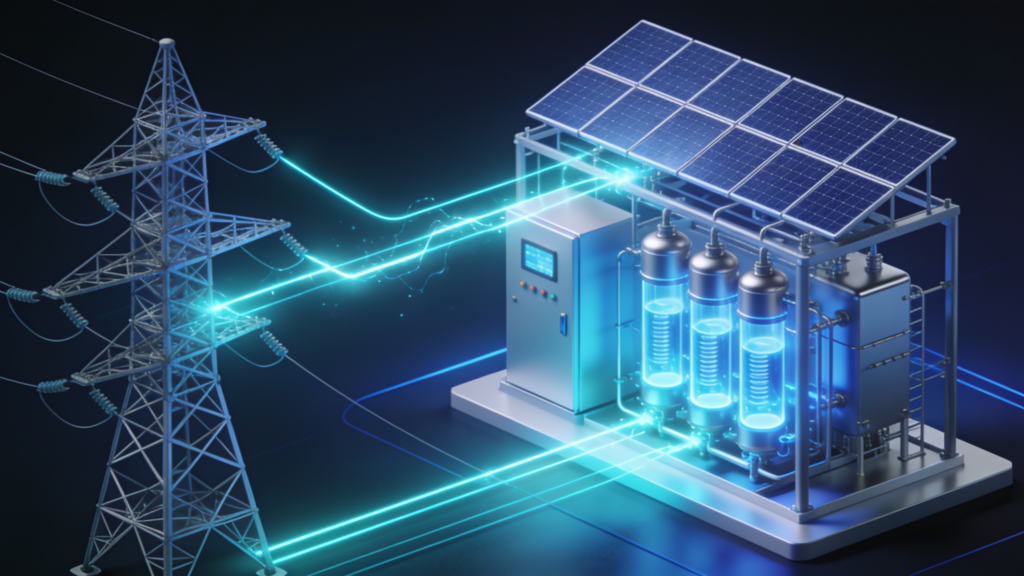
Large electrolyzer projects stall on grid integration more often than they stall on chemistry. The problem splits into two parts: getting an interconnection approved, and operating cleanly once connected. This guide breaks down both, plus the off-grid alternative a growing number of projects are choosing instead.
Why Grid Integration Is a Two-Part Problem
A large electrolyzer is a new kind of grid customer. It can demand as much power as a small city, and unlike most industrial loads, it can swing up and down with solar or wind output rather than staying flat. Utilities respond with long interconnection queues, costly reinforcement studies, and grid codes the plant must meet before it can operate. Each of these steps adds years and cost to a project timeline.
The technical problems are real too, but most are solvable with the right power electronics, controls, and, increasingly, by not connecting to the public grid at all.
The Interconnection Queue Is the First Wall
Before a single turbine or electrolyzer stack goes in the ground, the project has to clear the interconnection queue. A gigawatt-class electrolyzer can demand as much power as a small city, and grid operators have to study whether the local network can deliver that power without destabilizing other users. These studies, combined with permitting, routinely take years. Industry analysts list grid interconnection bottlenecks and permitting delays among the persistent constraints holding back large-scale electrolysis.
The scale of the impact shows up in the data. The IEA’s 2025 review found that announced low-emission hydrogen production planned for 2030 fell to 37 million tonnes a year, down from 49 million tonnes the year before, with electrolysis projects accounting for more than 80 percent of that drop. More than half of announced electrolyzer capacity is now set to miss its target operational date, and interconnection and permitting delays are among the causes.
When the grid can’t deliver on schedule, developers face three options: wait in the queue, pay for grid upgrades, or build dedicated generation. Each option changes project economics, and electricity already accounts for 50 to 60 percent of the levelized cost of hydrogen, so delays compound rather than pause the cost problem.
Three Technical Problems Once You’re Connected
Assume the connection is approved. A large electrolyzer still creates engineering challenges for the grid it just joined.
Power quality: Electrolyzers run on direct current, so they need rectifiers to convert grid AC. Thyristor-based rectifiers, common at industrial scale, inject current harmonics back into the grid and pull reactive power, especially at partial load. This degrades power quality for other grid users and adds losses inside the electrolyzer stack, typically requiring filters or compensation equipment to correct.
Voltage and frequency: As renewable penetration rises, the grid loses the rotational inertia that conventional power plants once supplied, making voltage and frequency more sensitive to disturbance. A large, fast-changing electrolyzer load can worsen this unless it’s deliberately designed to help stabilize the grid instead. Some electrolyzers are being studied as grid-support assets capable of reactive power support or grid-forming services, but that requires purpose-built design; it isn’t a default capability.
Variability: Most conventional electrolyzers were built for steady baseload operation. Paired with solar or wind, the load has to ramp constantly, and most conventional systems degrade or run inefficiently under that kind of frequent cycling.
Do you know what actually determines whether an off-grid hydrogen project needs a battery? The answer comes down to electrolyzer architecture more than renewable capacity.
Why Grid Connection Isn’t Always the Right Goal
It’s easy to frame grid integration as a problem to solve through a better connection. The harder truth is that connecting a renewable-powered electrolyzer to the grid can defeat the purpose of building it in the first place. If the plant draws grid power whenever the sun isn’t shining, the hydrogen is no longer fully renewable and may fail standards such as the EU’s Renewable Fuels of Non-Biological Origin rule. Staying grid-connected purely for backup doesn’t solve this either; the plant still inherits the queue, the grid codes, and the power-quality obligations.
That’s why a growing share of projects go off-grid instead, pairing the electrolyzer directly with solar or wind and skipping the public grid network entirely. This removes the interconnection delay and the grid-code burden, but it shifts the entire flexibility burden onto the electrolyzer, which now needs to handle constant on-off cycling and a wide load range on its own. Conventional alkaline and PEM systems tend to struggle here.
H2Pro’s Approach: Skipping the Grid Entirely
H2Pro is commercializing Decoupled Water Electrolysis, or DWE, an electrolyzer architecture built specifically for off-grid, renewable-following operation. Instead of producing hydrogen and oxygen at the same time across a membrane, DWE separates the two gases in time. H2Pro says this allows the system to be switched on and off an unlimited number of times without the degradation that affects conventional electrolyzers, while staying efficient across a wide load range.
The company’s Spain project is the clearest real-world test of the approach. H2Pro describes it as the first entirely off-grid solar-to-hydrogen facility built for gas-grid blending, starting at 5 MW of DWE wired DC-to-DC to 10 MWp of solar, with plans to scale to 50 MW backed by up to 80 MWp of solar. Wiring the electrolyzer directly to the solar array instead of the grid means the design sidesteps both the interconnection queue and the power-quality obligations that come with a grid tie.
The table below lays out how different grid-integration approaches compare, including where H2Pro’s off-grid design sits relative to the alternatives.
| Approach | Grid connection | Handles intermittent power | Key integration burden |
|---|---|---|---|
| Grid-connected electrolyzer (conventional) | Required | Poorly, without backup | Interconnection queue, grid codes, harmonics, reactive power, high electricity costs |
| Renewable + grid backup | Required | Yes, but draws grid power | Still subject to queue and grid codes; renewable status at risk |
| Fully off-grid (renewable-direct) | None | Must cycle constantly | Needs a flexible, durable electrolyzer; no grid services available |
| H2Pro DWE (off-grid, membraneless) | None, in the Spain project | Designed for unlimited on/off cycling | Shifts the burden from the grid to electrolyzer flexibility |
The fully off-grid model removes every grid-side obligation, but only works if the electrolyzer itself can absorb the variability the grid would otherwise help smooth out. That’s the specific gap H2Pro’s architecture is built to close.
Curious whether off-grid electrolyzers can genuinely skip battery storage too? This episode walks through the same architectural question.
Bottom Line
Grid integration should be assessed before site selection, not after. Check the interconnection queue and reinforcement costs early, since they can add years to a timeline. Decide whether the plant genuinely needs the grid, or whether an off-grid, renewable-direct design fits the offtake better. If staying grid-connected, budget for power-quality equipment and confirm the electrolyzer meets local grid codes. And match the electrolyzer technology to the power profile: steady baseload favors conventional systems, while variable renewable power rewards architectures built for cycling.
The hardest part of a large electrolyzer deployment is usually not the chemistry. It’s the connection, or the decision to design around it entirely.
FAQ
Q: What are the two main grid integration problems for large electrolyzers?
A: Getting an interconnection approved, which can take years due to grid studies and permitting, and operating cleanly once connected, without degrading power quality or destabilizing voltage and frequency.
Q: How much of hydrogen’s cost comes from electricity?
A: Roughly 50 to 60 percent of the levelized cost of hydrogen, which is why interconnection delays and grid-related equipment costs weigh so heavily on project economics.
Q: What is H2Pro’s Decoupled Water Electrolysis technology?
A: A membraneless electrolyzer architecture that produces hydrogen and oxygen at separate times instead of simultaneously across a membrane, using nickel-based electrodes with no platinum-group metals or PFAS.
Q: How does H2Pro’s off-grid design avoid grid integration problems?
A: By wiring the electrolyzer directly, DC-to-DC, to on-site solar generation instead of the public grid, which removes the interconnection queue and grid-code obligations entirely.
Q: What scale is H2Pro deploying its technology at?
A: A 0.5 MW pilot in Israel, moving toward a commercial demonstration in Spain that starts at 5 MW paired with 10 MWp of solar, with plans to scale to 50 MW backed by up to 80 MWp of solar.
Q: Can hydrogen made off-grid still reach existing gas infrastructure?
A: Yes. In H2Pro’s Spanish project, hydrogen produced off-grid is planned for blending into the natural gas pipeline operated by Enagás, with a later connection to the planned H2Med hydrogen corridor.